Career Advice
Salary Negotiation for Software Engineers in 2026: Bands and Scripts
David Eric ·

Most engineers still take the first number. The ones who counter mostly get paid for it.
The evidence is unusually consistent. In Pew's national survey, fewer than a third of workers asked for more than the initial offer the last time they were hired, and 38% of the ones who didn't said they simply didn't feel comfortable asking. Among the ones who did ask, two thirds got something: 28% got exactly what they asked for and another 38% got more than the original offer. Fidelity's survey puts the hit rate for people who counter at 87%. ZipRecruiter's spring 2026 survey of new hires puts it at 90%. And the cleanest evidence is a randomized field experiment run with about 3,800 US tech job seekers recruited through levels.fyi: a light nudge to negotiate raised the share who countered, and the counteroffers were worth an average of 12.45%, roughly $27,000 a year on packages averaging around $220,000. A discount on professional negotiation coaching, by contrast, did nothing. People didn't need a coach. They needed permission and a script.
This post is the permission and the scripts, plus the part most negotiation advice skips: what the bands actually are in 2026, how the company built the one you're looking at, and where your leverage really comes from in a market where quits are at a decade low.
What are the bands in 2026?
Higher at the top, flat at the bottom, and public in more places than ever.
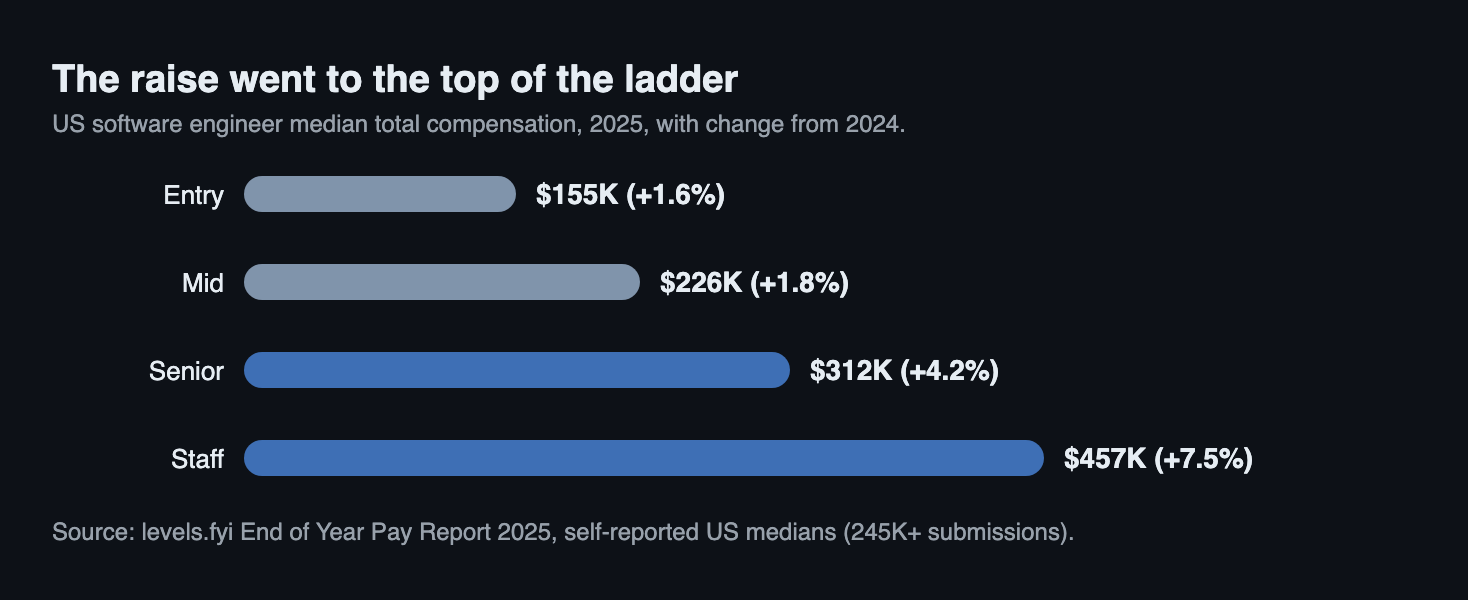
Start with the market-wide picture. levels.fyi's End of Year Pay Report for 2025, built on more than 245,000 self-reported submissions, puts US software engineer median total compensation at $155K for entry level, $226K for mid, $312K for senior, and $457K for staff. The growth pattern is the story: entry and mid moved under 2% year over year, senior moved 4.2%, staff 7.5%, and principal fell about 6.6%. The market paid more for exactly one thing in 2025, senior judgment, which matches what the posting data shows.
Now the named companies, because "senior engineer" means a different number at each one. Current levels.fyi medians, US, by level (all pulled September 16, 2026; levels.fyi updates these continuously, so expect drift of a few thousand dollars):
| Company | Mid-level | Senior | Staff |
|---|---|---|---|
| L4 $295K | L5 $428K | ||
| Meta | E4 $303K | E5 $434K | |
| Amazon | SDE II $272K | SDE III $404K | |
| Stripe | L2 $290K | L3 $449K | L4 $662K |
| Coinbase | IC4 $263K | IC5 $414K | IC6 $513K |
| Ramp | SWE $300K | Senior $510K | Staff $786K |
| Plaid | E4 $331K | E5 $467K | E6 $685K |
| Robinhood | IC4 $293K | IC5 $433K | IC6 $480K |
| Block | L5 $301K | L6 $425K |
Read across the senior row. The fintech names that people still describe as "paying less than Big Tech" are at or above Google and Meta at senior, and Ramp and Plaid are well above them at staff. The Big Tech versus fintech comparison goes deeper; for negotiation purposes the point is simpler. If a recruiter tells you a $430K senior package is "top of market," you now have five companies to name.
The splits matter as much as the totals. Google L5 is about $231K base and $166K stock. Stripe L3 is about $222K base and $198K stock. Ramp Staff is about $281K base and $505K stock. The higher the level, the more of the number is equity, and at a private company that equity has a valuation story attached, which is covered below.
How did the company build the band you're looking at?
From a market percentile, a midpoint, and a spread, and new hires land above the middle.
Compensation teams don't pick numbers by feel. Pave, one of the main comp-data vendors, describes the standard construction: pick the market percentile that matches your pay philosophy, make that the midpoint, then set the minimum and maximum by subtracting and adding a percentage, "typically between 5-20%." Most ranges "span roughly 20% to 40% from minimum to maximum." So a posted $190,800 to $262,800 band, which is what Plaid prints on its senior backend reqs, has a midpoint near $227K and was almost certainly built around a specific percentile of a specific peer set.
Two facts about where offers land inside that band, both from the company side:
→ New hires sit above midpoint. Pave's data on 15,000 new hires versus 51,000 existing employees found new-hire compa-ratios consistently higher, with AI and ML new hires at a median 1.05 (5% above midpoint) against 0.97 for the people already in the seat. When the market moves fast, companies pay the new person more than the incumbent. The recruiter knows this. Now you do.
→ The top of the band is a real place. Ashby, whose ATS runs a large share of tech hiring, published its own leveling and comp philosophy this summer: total comp targeted "greater than the 75th percentile for your level of performance," with offers that come in multiple salary-versus-equity shapes, "with both the minimum and maximum salary for the band." Coinbase set its targets at the 75th percentile in 2021. The 75th percentile is not a stretch ask at a company that says it targets the 75th percentile.
The single most useful question this gives you, asked to the recruiter once the range is on the table: "What separates a candidate you'd place at the top of that range from one you'd place in the middle?" It forces them to name the criteria, and then you can address them. It also tells you whether the gap is level, not negotiation, which is the most common reason an offer is lower than you expected.
Where do you find the real numbers?
Three sources, and each one lies in a different direction.
Posted ranges. As of this fall, fifteen states plus Washington, D.C. require a salary range in job postings: Colorado, California, Washington, New York, Hawaii, Maryland, Illinois, Minnesota, New Jersey, Vermont, Massachusetts, and, new in 2026, Virginia (July 1), Maine (July 29), and Connecticut (October 1, which also adds a benefits description). Delaware follows in 2027. In the EU, the Pay Transparency Directive's June 7, 2026 transposition deadline requires employers to give applicants the pay or pay range before the interview, though as of May only Slovakia had fully passed a law. The ranges are real (Colorado's law raised posted salaries about 3.6% at employers who posted before and after, per an NBER study) but they're base salary only, and they're often wide by design. Plaid's Staff AI Applications posting spans $264,660 to $369,800, a $105K gap that's decided by leveling.
levels.fyi. Self-reported total comp, including equity, by company and level. It's the best public view of the whole package, with two biases: it skews toward people who got good offers and want to share them, and private-company equity is imputed from tender and 409A prices, not a ticker.
H-1B filings. Every H-1B and E-3 petition requires a Labor Condition Application filed with the Department of Labor, and DOL publishes the disclosure files quarterly. Sites like h1bdata.info index them by employer and title. The catch: an LCA states the offered wage, which is base salary only. For 2025, Stripe filed 115 LCAs for "Software Engineer" at a median of about $152K, and Google filed nearly 5,000 at a median of $186K. Put Stripe's $152K LCA base next to its $290K L2 total on levels.fyi and you can see the shape of the package: the gap is stock and bonus, which no government filing will ever show you. Use LCA data to sanity-check the base, never the total.
How much leverage do you actually have in 2026?
Less than in 2022 for most people. More than most people think at senior and in AI.
The honest macro picture: the quits rate in July 2026 was 1.9%, a decade low outside the pandemic, and 1.0% in the Information sector, which means the people you'd be replacing aren't leaving and the company isn't desperate. Posted wages grew 2.5% over the year to July against 3.4% inflation. Software development postings are about a quarter below their pre-pandemic level. If you're negotiating an entry or mid-level offer, that's your environment, and it's why those medians barely moved.
The other half: software postings are up about 15% since early 2025 while overall postings fell, and 71% of that growth is senior roles. PwC's 2026 AI Jobs Barometer, across more than a billion job ads, finds workers with AI skills command a 62% wage premium, up from 57% a year earlier. Lightcast puts the premium on postings requiring AI skills at 28%, about $18,000. Dice's 2025 salary data has engineers building AI solutions earning 17.7% more than peers. The company that's paying an AI/ML new hire 5% above midpoint while the incumbent sits at 3% below is telling you, in comp-data language, that it can't find enough of you.
So calibrate your ask to which market you're in. An entry-level candidate in September 2026 negotiating a Google L3 offer has little room and should focus on level and start date. A senior engineer with two years of production ML work and a competing offer has more room than at any point since 2022.
The scripts
Six moments, one paragraph each. Say them roughly as written and then stop talking.
1. Before the first screen, when they ask for your expectations. Don't give a number before you've seen theirs, and in a transparency state you don't have to. "I'd rather not anchor on a number before I understand the level. What's the range for this role, and what level are you targeting?" If they push: "I'm targeting the market rate for a [senior] engineer with [payments infrastructure] experience. If the band is in that neighborhood, I'm happy to keep going."
2. When the range is on the table. "Thanks, that's helpful. What separates a candidate you'd place at the top of that range from one in the middle?" Then address those criteria, in the interviews and in your follow-up notes.
3. The counter, with a competing offer. Lead with enthusiasm, then the fact. "I want to work here, and I'd like to accept. I have a written offer from [company] at $[X] total. If you can get to $[X plus a modest margin], I'll sign this week." Name the total, not the base, and be able to show it.
4. The counter, without one. You still counter. "I'm excited about this. Based on what levels.fyi shows for [level] at [company] and comparable roles, I was expecting total comp closer to $[Y]. Is there flexibility on the equity to get there?" Equity is almost always the softer line; recruiters have more discretion on grant size than on base.
5. The equity questions, for a private company. "What's the current 409A and the last preferred price? What was the last tender, and who was eligible? What's the vesting schedule, and is there a refresher program?" A recruiter who can't answer the first two is telling you how the company thinks about employee equity.
6. The no-negotiation employer. Coinbase, Reddit historically, Buffer, and a growing list won't move on the number. Negotiate the thing they will move on. "I understand the offer is fixed for the level. Can we talk about whether I'm leveled correctly? Here's the scope I've owned." At a company where the package is set by level, the level conversation is the negotiation.
One rule across all six: get the final number in writing before you resign anything, and never counter with a number you wouldn't actually accept.
What do you need to know about the equity?
More than the recruiter will volunteer, because the equity is where 2026 offers vary the most.
The default shape. Four-year vest with a one-year cliff: nothing for twelve months, 25% at month twelve, then 1/48th a month. That's still the modal structure, but it's no longer universal. Oracle, Nvidia, and DoorDash front-load at 40/30/20/10. Google has used 38/32/20/10. Coinbase abolished the cliff entirely and issues one-year grants that vest 25% a quarter, re-sized every year. Ramp vests quarterly in year one and monthly after. Ask which one you're getting, because a four-year grant and four annual grants of the same headline size are very different bets on the company and on you.
Private paper. If the company is private, the offer letter's equity value rests on a price, and there are two of them. The preferred price is what the last investors paid. The 409A is the board's fair-market valuation for common stock, and it's typically discounted from preferred by 25 to 35% to reflect liquidation preferences and illiquidity. A recruiter will value your grant at preferred. You should know the 409A too.
Liquidity track record. The fintech companies in the table above are a useful spectrum. Stripe has run recurring tenders: $91.5 billion in February 2025 and $159 billion in February 2026, open to current and former employees. Ramp went from $13 billion to $44 billion in fifteen months and included employee tenders along the way. Plaid's $575 million round in April 2025 was partly to cover taxes on expiring RSUs and to offer the team liquidity, at a $6.1 billion valuation, down from $13.4 billion in 2021. All three are real companies with real equity. They're not the same asset, and "we're profitable and growing 40%" (true of Plaid) is a different story than "our tender price went up 74% in a year" (true of Stripe). Ask the recruiter for the history, and value the grant at both prices before you compare it to a public-company offer.
The fintech sidebar
For the engineers this blog is mostly written for, the negotiation at each of the four companies we've written guides on has a different shape:
→ Stripe publishes no no-negotiation stance and pays heavily in private stock with the best liquidity record in the group. Negotiate the grant; ask about the next tender. Stripe guide.
→ Coinbase will not negotiate. Same offer for the same role and location, 75th percentile, annual grants, no cliff. Your entire leverage is the level the loop assigns, so push on leveling before the onsite, not on dollars after it. Coinbase guide.
→ Ramp posts wide base ranges ($143K to $284K on a single frontend req), which means leveling decides most of the outcome. The stock is the upside story; its share of the package roughly triples from mid to staff. Ramp guide.
→ Plaid posts narrower bands and prices its AI roles about $100K above its other Staff seats. Vesting is either two-year or four-year depending on the grant, per levels.fyi, so ask which. Plaid guide.
The part where leverage actually comes from
Every script above works better with a second offer in hand, and the data says that's not a coincidence. The 12% average gain in the field experiment came from people who countered; the people who countered with alternatives did best. Which is why the negotiation starts weeks earlier than most engineers think, at the point where you decide how many well-matched applications go out in the same fortnight, early enough to land interviews that conclude in the same window. That's the mechanism hirecomb is built around: matched postings, tailored applications, sent the day they open, so the offers arrive together instead of one lonely offer a month apart. One offer is a decision. Two is a negotiation.
FAQ
Should I negotiate a software engineer offer in 2026, even in a weak market?
Yes. Fidelity's data has 87% of people who counter getting at least some of what they asked for; ZipRecruiter's spring 2026 new-hire survey has 90%. A randomized experiment with about 3,800 US tech job seekers found counteroffers worth about 12% on average, roughly $27,000. The weak market changes how far you can push and what to push on (level and equity rather than base at entry level), not whether to ask. Companies rarely rescind for a polite counter, and the ones that would are telling you something.
Should I give my salary expectations first?
Not if you can avoid it, and in fifteen states plus D.C. the posted range means you don't have to. Ask for the band and the target level before naming a figure. If pressed, describe your target as "market rate for a [level] engineer with [specialty]" and confirm their band is in range. Once a range is posted, the more useful question is what puts a candidate at the top of it.
How do I value private-company equity in an offer?
Get two prices: the preferred price from the last round and the current 409A, which is usually 25 to 35% lower. Ask about the last tender offer and who was eligible. Then compare the vesting schedule (standard four-year with a one-year cliff, front-loaded, or annual grants) to what the public-company offer gives you. Stripe and Ramp have run employee tenders recently; not every private fintech has.
What if the company says it doesn't negotiate?
Coinbase has had a formal no-negotiation policy since 2021, and a handful of others (Reddit historically, Buffer) use fixed formulas. At these companies the offer is set by level, so the level is what you negotiate: ask how you were leveled and make the case for the next one with the scope you've actually owned. Coinbase sets its bands at the 75th percentile, so the fixed number is often competitive; the point is to make sure it's the right band.
Sources: negotiation rates and outcomes, Pew Research Center (April 2023), Fidelity citing its 2022 Career Assessment Study, and ZipRecruiter New Hires Survey Q2 2026 (May 2026). Field experiment, Cullen, Pakzad-Hurson and Perez-Truglia, "Pushing the Envelope," NBER Working Paper 33903 (June 2025), with figures via UCLA Anderson Review. Compensation medians, levels.fyi End of Year Pay Report 2025 and company pages for Google, Meta, Amazon, Stripe, Coinbase, Ramp, Plaid, Robinhood, and Block (September 16, 2026). Band construction, Pave on salary ranges and Pave on new-hire compa-ratios; Ashby's engineering levels and compensation (July 2026). Pay transparency laws, Jackson Lewis (January 2026), Morgan Lewis on Virginia, Littler on Maine, Foley on Connecticut, Littler on the EU directive, and Arnold, Quach and Taska, NBER 34480. H-1B wage data, DOL OFLC disclosure data via h1bdata.info. Market context, BLS JOLTS July 2026, Indeed Hiring Lab (August 2026) and AI and job postings (July 2026), PwC 2026 AI Jobs Barometer, Lightcast, Dice 2025 Tech Salary Report. Equity mechanics, Holloway on vesting, a16z on 409A valuations, levels.fyi on front-loaded vesting. No-negotiation policies, Coinbase (May 2021), Buffer. Tenders, Stripe February 2025, Payments Dive on Stripe's 2026 tender, TechCrunch on Ramp, Plaid. Self-reported comp data skews toward strong offers; verify the level and the current figure before you quote a number in a negotiation.