Career Advice
Coinbase Software Engineer Interview Guide (2026)
Adam Ross ·

Stripe won't let you touch an AI assistant in its interviews. Coinbase grades you on how well you use one.
That is the single most important thing to know about this loop in 2026. Coinbase spent the past year rebuilding its engineering interviews around AI: a frontend pilot in late 2025, repo-based backend exercises from January 2026, and since March 2026 a company-wide evaluation signal it calls AI Fluency, scored at every stage of the loop. Candidates are expected to bring tools like Cursor, Copilot, or Claude into the coding rounds, and the interviewers are watching how you direct them, verify their output, and explain what the code actually does.
This guide covers the full process as of 2026: every round, verified pay bands, the unusual comp structure, and the engineering roles open right now. One honesty note up front: Coinbase's loop changed substantially during 2025 and 2026, so older Glassdoor and Blind write-ups describe a process that no longer exists. What follows leans on Coinbase's own engineering blog for the new format and on candidate-report consensus for the parts the company doesn't publish; where something is thinner than that, we say so.
Why is Coinbase such a target for engineers in 2026?
Because it is the rare company where the crypto bet comes with an S&P 500 listing, remote-first hiring, and top-of-market pay you don't have to negotiate for.
The scoreboard, honestly stated: Coinbase joined the S&P 500 in May 2025, the first crypto company in the index, and closed the largest crypto acquisition to date three months later, buying the derivatives exchange Deribit for about $2.9 billion. Q2 2026 was rockier on paper, with revenue around $1.2 billion and a quarterly loss that missed estimates, but the same quarter set a third consecutive record for crypto trading volume market share at 10.3% and marked the company's 14th straight quarter of positive adjusted EBITDA. Crypto earnings swing with the assets on the balance sheet; the underlying exchange business has stayed profitable through the cycle.
The structural facts matter more for candidates. Coinbase has operated as a remote-first company with no headquarters since 2020, and its current job board reflects it: nearly every US engineering role is listed as Remote - USA. Headcount runs lean, roughly 4,250 people after a May 2026 restructuring, for a product surface that spans an exchange, custody, payments, stablecoins, and a blockchain. If you're weighing the sector broadly, our fintech engineering guide covers where Coinbase sits in the landscape, and the big tech vs fintech comparison covers the trade you're making. This post is about getting through Coinbase's door specifically.
One more piece of context you should walk in knowing: that May 2026 restructuring cut about 700 roles, roughly 14%, and the company's stated reason was rebuilding as an AI-native organization, with smaller teams and fewer layers. Coinbase is simultaneously cutting and hiring, which is the pattern across fintech right now, and it tells you exactly what the interviews are optimizing for.
What does Coinbase's interview loop look like?
Four to five stages, typically six to eight weeks end to end, per candidate reports:
→ Recruiter screen, ~30 minutes. Background, motivation, logistics. Coinbase has also piloted AI-conducted screening calls for some roles since 2025; candidates on Blind describe a ~15-minute conversational AI screen (some report it under the name Milo). Treat it as a real interview, not a formality.
→ Online assessment. Most reports describe a ~90-minute CodeSignal assessment for early-career and mid-level roles, scored on correctness and code quality. Some teams substitute a take-home or skip straight to the phone screen at senior levels.
→ Technical phone screen, ~60 minutes. A practical coding session, pair-programming style, on CoderPad or similar depending on the team.
→ Virtual onsite, ~4 rounds. The common shape: two pair-programming rounds (60 to 90 minutes each), one system design round, and a behavioral round with the hiring manager. Since January 2026, backend loops use repo-based exercises: you work inside a realistic multi-file repository rather than a blank editor, with an AI assistant available, and the round grades how you navigate, extend, and verify code in context.
→ Offer. Level (IC3 through IC7+) is set by the loop. There is no negotiation stage, for reasons covered below.
Two structural notes. First, the loop is more decentralized than Stripe's; formats and platforms genuinely vary by team, so ask your recruiter exactly which rounds you're getting rather than assuming this list. Second, everything happens over video. Coinbase has no office to fly you to, and the loop doubles as a test of whether you communicate well remotely, in writing and on calls.
What is AI Fluency, and how do you not fail it?
It is a formal evaluation signal, scored at every stage of the loop since March 2026, measuring three things: whether you use AI tools at all, whether you apply them to the right problems, and whether you understand their limits.
The backstory explains how seriously to take it. In mid-2025, Brian Armstrong gave every Coinbase engineer a week to onboard to Cursor and Copilot, then fired those who hadn't and had no good reason, a story he told himself on Stripe's Cheeky Pint podcast and described as heavy-handed. By September 2025 he posted that "40% of daily code written at Coinbase is AI-generated," with a target above 50%. The May 2026 restructuring was framed in the same language. The interview change is the hiring-side arm of that campaign, and Coinbase's engineering blog is explicit that no rounds were added: the existing rounds now watch how you work with the tools.
What interviewers reward, per the company's own write-up: directing the AI with clear, decomposed prompts; reviewing and testing what it produces instead of pasting it in; and being able to explain every line you ship. What fails: typing the problem into the assistant and reading back the answer, and, at the other extreme, refusing the tools on principle and grinding manually while the clock runs.
Worth knowing the counterargument, because your interviewer does. When the blog post hit Hacker News in August 2026, the pushback was about fairness (candidates arrive with different tools and different subscription tiers) and about whether the format selects for people who can't work without a copilot. Coinbase's position is that AI-assisted engineering is the job now, so the interview should sample the job. Whatever you think of that, it is the most honest possible signal about what working there is like.
What does Coinbase pay software engineers?
Top of market, no negotiation, and equity that vests in one year instead of four.
Levels run IC3 through IC8. Self-reported US medians from levels.fyi, current as of August 2026:
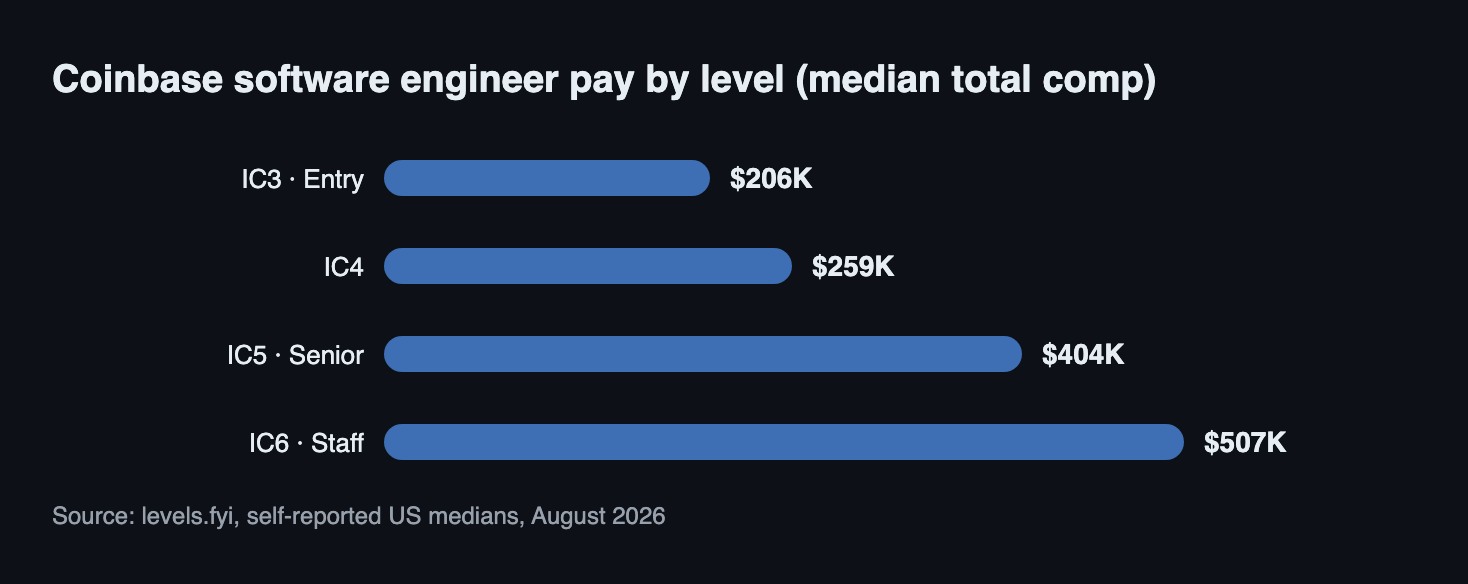
Splits at IC5, for shape: roughly $207K base, $179K stock, $18K bonus. The overall US median across all Coinbase engineers sits at $388K.
Three structural quirks matter more than the medians:
→ There is no negotiation. Coinbase announced in May 2021 that it eliminated salary and equity negotiation entirely: same offer for the same role and location, targeted at the 75th percentile of the tech market. The policy was announced by its Chief People Officer as an equity measure, since negotiation outcomes skew against women and underrepresented candidates. It is still reflected in how offers land per levels.fyi and negotiation firms in 2026. Practically: your leverage is the level you interview at, not the back-and-forth after.
→ Equity vests in one year. Instead of a four-year new-hire grant, Coinbase issues annual grants that begin vesting immediately, 25% per quarter. You're never more than a quarter from your next vest, and there's no cliff hostage year; the trade is that future years' grants aren't locked in upfront, so your equity resets to market (and to your performance) annually.
→ You can take pay in crypto. Coinbase has offered fee-free direct-deposit conversion into crypto since 2021. Optional, and most treat it as a checkbox rather than a comp strategy, but no other company in our company guide series offers it at all.
The stock itself is public (COIN), so unlike private fintech equity there's no imputed-valuation asterisk; there is instead genuine volatility, and a 1-year vest cadence that softens it.
What is Coinbase actually screening for?
Mission alignment, ownership, and whether you can operate in an intense, remote, writing-heavy culture.
Coinbase is unusually explicit about its culture, and the interviews track it. The 2020 memo that made the company famously apolitical ("Coinbase is a mission focused company") is still the cleanest read on the environment: the mission is economic freedom via crypto, workplace activism on unrelated causes is out of scope, and about 5% of the company took the exit package rather than sign on. You do not need to be a crypto maximalist, but "why Coinbase" is a real question here in a way it isn't at most companies, and a generic answer reads as a miss on the company's first filter.
The published cultural tenets that surface most in behavioral rounds: clear communication, efficient execution, act like an owner, and positive energy. Remote-first sharpens the first one; expect your written artifacts (take-home notes, follow-up emails, even how you narrate in pair rounds) to be read as signal. Prep your stories properly: incidents you owned, disagreements you resolved with evidence, work you can defend at the level of detail only the person who did it would know. Our behavioral interview guide for engineers is the companion piece for this round.
And since March 2026, AI Fluency sits alongside all of the above as an explicit, company-wide signal. It is the one axis where Coinbase differs from every other loop in this series.
Which Coinbase engineering roles are open right now?
As of August 26, 2026, Coinbase's board lists 176 open roles, 66 of them with "engineer" in the title, and the overwhelming majority remote. A representative cut, with direct application links:
| Role | Focus | Location |
|---|---|---|
| Software Engineer | Generalist | Charlotte, NC |
| Senior Software Engineer | Generalist, senior | Remote, USA |
| Senior Software Engineer, Stablecoins | Stablecoins | Remote, USA |
| Senior Software Engineer, Frontend (Consumer - Payments) | Payments frontend | Remote, USA |
| Senior Software Engineer, Core AI Infrastructure | AI infra | Remote, USA |
| Senior Software Engineer, Blockchain Platform Nodes | Blockchain infra | Remote, USA |
| Staff Software Engineer, Backend (Consumer - Prediction Markets) | Prediction markets | Remote, USA |
| Staff Software Engineer, Backend - FinHub (Ledger) | Core ledger | Remote, USA |
| Software Engineer, Frontend (Coinbase Advisor - Agentic Trading) | Agentic trading | Remote, USA |
| Staff Software Engineer, Solana Staking Protocol | Staking protocol | Remote, USA |
| Senior Staff Software Engineer, Payments | Payments, senior staff | Remote, Canada |
| Machine Learning Engineer | ML | Remote, India |
Beyond the US and Canada: active engineering postings in India, Brazil, Singapore, and Israel. The full board is here.
Note the team names: prediction markets, stablecoins, agentic trading, core AI automation. That is where the post-restructuring headcount is going. These listings churn, and fresh postings are where your odds actually live, which is exactly why ApplyIn watches for new roles matching your stack and applies the day they open rather than the week you next check the board.
How should you prep differently for Coinbase?
Prep the AI-assisted workflow as a skill, because that is what's being graded:
→ Do timed exercises with your assistant, out loud. Pick a mid-sized repo, pick a small feature or bug, and practice the full loop: decompose the task, prompt the tool, review its output critically, test it, and narrate why you accepted or rejected what it gave you. The narration is the interview.
→ Practice catching the AI being wrong. Interviewers probe whether you understand the tool's limits. Deliberately work on problems where assistants hallucinate (concurrency, off-by-one boundaries, unfamiliar APIs) until spotting the failure is reflexive.
→ Drill repo navigation, not blank-page coding. The backend rounds put you in an existing codebase. Orienting fast in unfamiliar code is a trainable skill, and it's the same muscle as Stripe's Bug Squash round; the Stripe guide has the drill.
→ Flavor system design with exchange and ledger reality. Order matching, idempotent transfers, double-entry ledgers, custody and key-management boundaries, rate limits under volatile load. Reaching for these unprompted reads like someone who wants this job, not a job.
→ Have a real answer to "why crypto." Mission alignment is a genuine filter here. It doesn't need to be ideological; "I want to build financial infrastructure with actual users and this is where that's happening" is honest and sufficient. Rehearsed evangelism is worse than candor.
→ Write your story bank before the recruiter call. Six stories indexed against ownership, communication, and disagreement, per the behavioral guide.
And make sure the resume that starts all this survives parsing; the ATS-proof resume guide applies here like everywhere else, with one addition: AI-tooling experience on the resume (agents you've built, workflows you've automated) is now directly relevant signal for this specific company.
FAQ
Can I use AI tools like Cursor or Claude in a Coinbase interview?
Yes, and since March 2026 you're expected to. Coinbase's engineering blog describes AI Fluency as a signal evaluated at every stage: whether you use the tools, apply them well, and understand their limits. Ask your recruiter what setup each round uses, then practice in that exact configuration. Refusing the tools reads as a negative signal here, which is the exact inverse of Stripe's loop.
How long does Coinbase's interview process take?
Six to eight weeks from recruiter screen to offer in the common case, per candidate reports. The loop is decentralized by team, so timelines vary more than at companies with a single standardized pipeline; a competing offer with a deadline is the reliable way to compress it.
Is Coinbase fully remote?
Effectively yes for engineers. The company has described itself as remote-first with no headquarters since 2020, and nearly every current US engineering listing is Remote - USA, with remote roles also posted in Canada, India, Brazil, Singapore, and Israel. The interviews are fully virtual, and they double as a test of how you communicate remotely.
Can you negotiate a Coinbase offer?
No. Coinbase eliminated salary and equity negotiation in 2021 and pays a stated 75th-percentile target, with identical offers for the same role and location. Your comp is determined by the level the loop assigns you, which makes the leveling conversation with your recruiter the highest-stakes negotiation-shaped moment in the process. If you believe you're interviewing below your level, raise it before the onsite, not after the offer.
The honest summary: Coinbase runs the first major interview loop that grades you on AI-assisted engineering rather than banning it, wrapped around a pair-programming format, a mission filter, and comp that's high, public, fast-vesting, and non-negotiable. The prep is different from every other company in this series: practice working with the tools, out loud, until directing an AI reads as naturally as writing a for-loop. Then apply while the posting is fresh, and interview for the level you actually operate at, because here the level is the negotiation.