Career Advice
Big Tech vs Fintech for Engineers in 2026: Comp, Interviews, Stability
Adam Ross ·

Everyone's still queuing for the same seven logos. That's the entire case for looking elsewhere.
We posted a short version of this argument earlier this year and got the same two replies every time: "fintech pays less" and "fintech is boring." One of those is out of date. The other is true, and it's the point.
This is the long version. Three axes, comp, interviews, and stability, each with numbers you can check, and an honest account of where fintech is worse. Because it is worse in places, and the places matter.
Does Big Tech still pay more than fintech?
At the senior level, no. Not anymore.
Pull the verified US medians on levels.fyi for a senior engineer and the "fintech discount" is gone at the companies people actually mean when they say fintech:
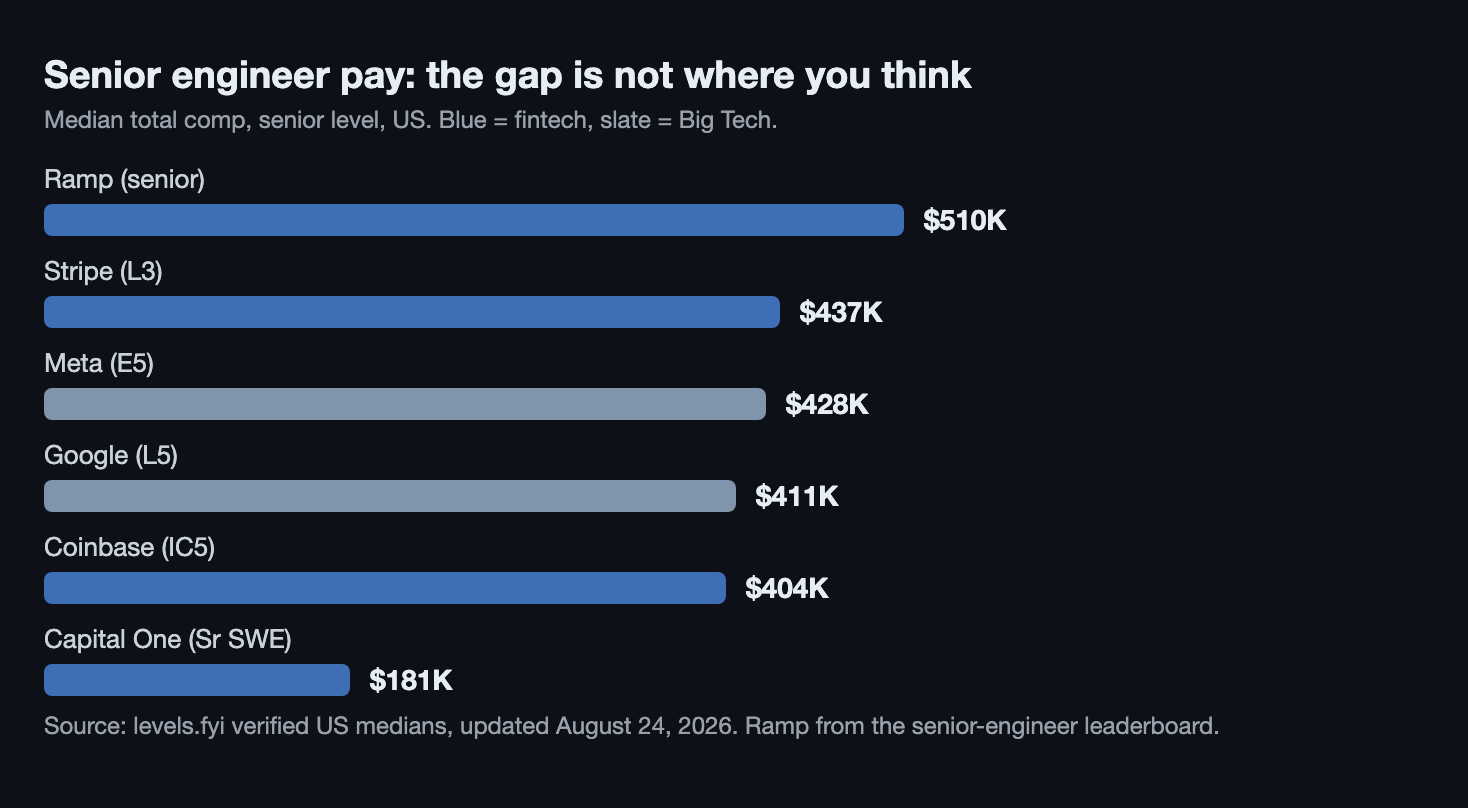
Stripe L3 at $437K sits above Meta E5 at $428K and Google L5 at $411K. Coinbase IC5 is a hair under at $404K. Ramp, at $510K for a senior engineer, is on levels.fyi's top-20 leaderboard for the level, ahead of every Big Tech name. These are medians from verified offers, updated this week, not recruiter anecdotes.
Two things that chart hides, and both cut against fintech:
The ceiling is still Big Tech's. Meta E6 is $702K and Google L6 is $676K. Stripe L4 is $683K, so the top private fintechs keep pace, but the deep bench of $1M-plus staff and principal roles is mostly in Mountain View and Menlo Park. If you're an L7-track engineer, this post isn't for you.
"Fintech" includes the banks, and the banks pay half. Capital One's senior software engineer median is $181K. JPMorgan and Goldman are in the same band. The bank track is a real career with real stability, and it is not a comp match for Big Tech at any level. When someone says fintech pays less, they're usually thinking of a bank.
The comp shape differs too. Big Tech comp is roughly a third to a half stock, refreshed annually, at a public price you can sell. Private fintech comp is a similar stock fraction at a tender-offer price you may or may not get to sell this year. Stripe and Ramp have run regular tenders; most private fintechs haven't. Discount the paper accordingly, and then notice the chart still holds.
For the rest of the pool, entry and mid-level, the picture is closer. Levels.fyi's 2025 pay report puts the US median for an entry-level engineer at $155K and for a mid-level engineer at $226K across all companies, and Big Tech and top fintech both sit above those lines at similar heights: Google L3 $211K against Stripe L1 $210K, Google L4 $288K against Stripe L2 $290K. Same money. The difference is how many people are in line for it.
Which interview loop is easier to get through?
Neither is easy. Fintech's is shorter, more predictable, and tests things you already do at work.
Calibrd's 2026 interview report, which hand-counts every evaluative round for 31 roles, puts a senior software engineer loop at 6 rounds on average and the FAANG loops at the top of the range, 7 to 8 once you add the bar raiser. That's the baseline: a recruiter screen, an online assessment or phone screen, then four or five onsite rounds, usually two of them algorithmic.
Fintech loops vary more by company, which is itself useful, because you can pick the loop that matches how you're good:
→ Stripe runs no LeetCode-style algorithms at all. The loop is a bug squash in an unfamiliar codebase, an integration round against a real API, a practical coding round, and a system design round, all in your own editor. We've written the full Stripe guide; the short version is that it rewards people who are good at the job, not people who trained for the test.
→ Coinbase is closer to the Big Tech shape, remote-first, with a coding round, a system design round, and a behavioral round that leans hard on ownership. Expect a live pairing session rather than a whiteboard.
→ Ramp runs an in-person loop and moves fast. Practical coding, a design round scoped to a real Ramp-shaped problem, and a strong emphasis on speed of judgment. Two weeks from screen to offer is normal; two months is not.
→ Banks are process-heavy and slow, six to eight weeks, with a HireVue-style recorded round early and a panel late. The technical bar is lower than any company above. The patience bar is higher.
The pattern: the companies paying Big Tech money in fintech run loops that look like the work. Fewer rounds, less algorithmic trivia, more "here's a codebase, here's a bug, go." If your last two years were spent shipping rather than grinding, that's a bar you clear more easily than the eight-round version.
The one place Big Tech's loop is genuinely more forgiving: it's standardized. Grind the same 150 problems and you're prepared for Google, Meta, and Amazon at once. Every fintech loop wants something slightly different, and you have to prep each one.
What both loops now test that they didn't in 2024. AI-tool policy. Stripe and Ramp let you use your normal setup, including assistants, and then ask harder questions about why the code is correct. Most Big Tech onsites still ban tools in the coding rounds. Know the policy before the loop, and if tools are allowed, practice explaining AI-generated code out loud, because that's the actual test.
Which one is more stable?
This is where the honest answer is complicated, and where the LinkedIn version of this argument gets it half wrong.
The half it gets right: Big Tech's 2026 has been brutal. TechCrunch's running layoff tally has US tech companies cutting nearly 140,000 jobs since January, with Amazon, Oracle, Meta, and Microsoft accounting for almost 50,000 of them. Amazon cut 16,000 corporate roles in January on top of 14,000 in October, about 9% of its corporate workforce in three months. Meta cut 8,000 in May, 10% of the company. Oracle is down 21,000 over twelve months. Google has been trimming through performance reviews and buyouts rather than announcements, which is worse for you, because there's no headline to warn you.
Layer on SignalFire's data and the shape is clear. New-grad hiring at the tech majors is down roughly 65% from 2019, and new grads went from 15% of Big Tech hires before the pandemic to about 7% in 2025. Engineering hiring overall is down only 11% at those companies, which means the seats that exist are senior seats, and they're the ones getting reorganized every quarter.
The half the LinkedIn version gets wrong: fintech is not immune. It's not even close.
In the same tally, Block cut 4,000 jobs in February, nearly half the company. PayPal announced 4,500 cuts, 20% of its workforce, in May. Coinbase cut 700 the same week, 14% of staff, after trading volumes fell off the October crypto peak. If you were an engineer at a consumer-facing or crypto-exposed fintech in the first half of 2026, your year was worse than a Meta engineer's.
So "fintech is stable" is wrong as stated. What's true is narrower and more useful:
Payments and B2B infrastructure held. Stripe has been net-hiring all year with roughly 500 open roles, two-fifths of them engineering, and hasn't cut since 300 roles in January 2025. Ramp is growing headcount. The rails that move business money didn't have a demand problem.
Banks didn't cut engineers. Bank modernization budgets are set against regulatory deadlines and core-system risk, not ad revenue or crypto prices. The comp is half of Stripe's, but so is the variance.
Consumer and crypto fintech behaved like consumer tech. Block, PayPal, Coinbase, Robinhood: revenue tracks retail activity and sentiment, and headcount follows revenue. Treat these as Big Tech-grade volatility with a smaller cushion.
The stability argument for fintech is really a stability argument for boring fintech: payments infrastructure, B2B spend, and regulated money movement. Those are the durable problems, and they're also, not coincidentally, where the comp chart above is strongest.
So where should you point your next application?
Start from what you're optimizing for, not from the logo.
| You want | Big Tech | Top fintech (Stripe, Ramp, Plaid) | Consumer / crypto fintech | Bank |
|---|---|---|---|---|
| Max senior comp | $410K to $430K median | $437K to $510K median | ~$400K | ~$180K |
| Comp ceiling (staff+) | Highest | Matches at staff, thins above | Thins above senior | Lowest |
| Liquid equity | Yes | Tender offers, irregular | Yes (public) | Yes, small |
| Loop length | 7 to 8 rounds, standardized | 4 to 6 rounds, practical | 5 to 6 rounds | 4 to 5, slow |
| 2026 layoff exposure | High (30K at Amazon alone) | Low (net hiring) | High (Block, PayPal, Coinbase) | Low |
| New-grad odds | ~7% of hires | Low, senior-skewed | Low | Best: structured programs |
| Competition per posting | Extreme | Moderate | Moderate | Low |
Three readings of that table:
If you're senior and shipping. Top fintech is the better risk-adjusted bet right now, and it isn't especially close. Equal or better pay, a shorter loop that tests what you do, a thinner crowd, and the lowest layoff exposure of any well-paid corner of the market. Apply to Stripe, Ramp, and Plaid with the same seriousness you'd give Google, and use the fintech playbook to speak the vocabulary.
If you're staff-plus. Big Tech still owns the top of the comp curve, and the reorg risk is the price of that curve. Take it with eyes open, and keep a fintech loop warm; Stripe L4 at $683K is a real number.
If you're a new grad. Neither Big Tech nor top fintech is built for you this year. Big Tech's new-grad door is at 7% of hires and closing. The honest path is the structured bank or large-fintech program, then a lateral to Stripe-tier in two or three years with a ledger and a fraud system on your resume. We covered why the junior ladder broke, and a bank rotation is one of the few intact rungs.
Avoid regardless of level: applying to consumer and crypto fintech on the theory that it's the safe version of tech. It isn't. Do it for the product or the comp, not for the stability.
The part nobody puts on a comparison table
The reason the crowd is thinner in fintech has nothing to do with the work. It's that the logo doesn't impress anyone at a party. That's a status tax, and it's the only real cost on the fintech side of the ledger.
Everything else on that side is an edge that exists because other engineers won't pay the tax: the same money, fewer rounds, fewer applicants per posting, and a category of company whose revenue doesn't evaporate when ad budgets or coin prices do.
We built ApplyIn to find postings while they're hours old and get real applications in before the pile grows. It works in any corner of the market. It works best in the corners where the pile is small to begin with, and in 2026 that corner has columns on the building.
FAQ
Does fintech pay less than Big Tech in 2026?
At the senior level, no: levels.fyi's verified US medians put Stripe L3 at $437K and Ramp at $510K, against Meta E5 at $428K and Google L5 at $411K. Above staff, Big Tech's ceiling is still higher. Banks are a separate track and pay roughly half of either, so check which kind of fintech you mean before assuming a discount.
Are fintech interviews easier than FAANG interviews?
Shorter and more practical, not easier. FAANG loops average 7 to 8 rounds with heavy algorithmic content. Stripe runs no LeetCode at all and tests you in a real codebase; Ramp runs a fast in-person loop; Coinbase is closest to the Big Tech shape. The trade-off is that each fintech loop needs its own prep, while one round of LeetCode covers all of Big Tech.
Is fintech safer from layoffs than Big Tech?
Only part of it. Payments infrastructure and B2B fintech (Stripe, Ramp) net-hired through 2026, and banks didn't cut engineers. But Block cut nearly half its staff, PayPal announced 20% cuts, and Coinbase cut 14%. Consumer and crypto fintech carry Big Tech-grade volatility. Judge the business model, not the category label.
Should a new grad target Big Tech or fintech?
New grads are about 7% of Big Tech hires and top fintechs skew senior, so neither is a good cold-apply target. Structured programs at banks and large fintechs still have defined intakes. Take one, build ledger and fraud-system experience, and lateral to Stripe-tier in two or three years.
Is fintech equity worth as much as Big Tech RSUs?
Public fintech and Big Tech stock is liquid at a market price. Private fintech equity is valued at the last round or tender price, which you can only sell when the company runs a tender. Stripe and Ramp have run regular tenders; many private fintechs haven't. Discount private paper, and compare offers on cash plus a haircut on equity rather than headline total comp.
The market didn't get fairer this year. It got more lopsided, and the lopsidedness is the opportunity: the pay moved, the crowd didn't. Point your search where the two have come apart.