Career Advice
Ramp Software Engineer Interview Guide (2026)
David Eric ·

Ramp's interview starts before you are allowed to apply.
For years, some of Ramp's engineering postings have hidden the real application link behind a small puzzle: decode a base64 string, dig through the DOM for a flagged element, follow the trail to a short coding task. Candidates have been comparing notes on it on LeetCode's discussion board since 2023, and a few have open-sourced their solutions on GitHub. It is a capture-the-flag exercise standing in for a cover letter, and it tells you most of what you need to know about how this company thinks about hiring: the filter is whether you will go and figure something out, unprompted, when nobody has told you how.
This guide covers the full process as of September 2026: every stage, verified pay, the puzzle gate, the culture the behavioral rounds are really testing for, and the engineering roles open right now. One honesty note up front. Unlike Stripe and Coinbase, Ramp does not publish an official interview-format post, so the loop below comes from candidate reports (Glassdoor, Blind, interview-prep sites) cross-checked against Ramp's own careers page, job postings, and engineering blog. Where a detail rests on a handful of reports rather than a company statement, we say so.
Why is Ramp such a target for engineers in 2026?
Because it is the fastest-scaling private fintech in the country, and it is profitable while doing it.
The scoreboard: Ramp raised a $750 million Series F at a $44 billion valuation in June 2026, led by ICONIQ, GIC, and Ontario Teachers'. That is the fifth valuation step-up in fifteen months, from $13 billion in a March 2025 tender offer to $16 billion, $22.5 billion, $32 billion, and now $44 billion. The company passed $1 billion in annualized revenue in 2025 with positive free cash flow, serves more than 70,000 businesses, and moves about $200 billion a year in purchase volume, which grew roughly 170% year over year in March 2026. Its own careers page puts it more bluntly: growing "10x faster than the median publicly traded SaaS company."
The structural facts matter more for candidates. Ramp is a New York company in a way few tech companies are anymore: headquarters on West 23rd Street, satellite offices in San Francisco and Miami, relocation support to NYC written into the benefits list, dinner served every night of the week. Nearly every engineering posting is listed as hybrid with New York as the primary location, and some carry Remote (US) and Remote (Canada) as secondary options. Employee reviews collected in May 2026 describe new hires being expected in the office three or more days a week. If you want the remote-first version of fintech, that is Coinbase. Ramp is the in-person one.
The leadership change in June 2026 is worth knowing as context for the interviews. Co-founders Eric Glyman and Karim Atiyeh became co-CEOs, Rahul Sengottuvelu (previously head of applied AI, and a co-founder of the Cohere startup Ramp acquired) became CTO, and Glyman framed the reshuffle around AI: every part of the company positioned to leverage the "continued explosion in model intelligence." That is not just investor language. Ramp's internal coding agent, Inspect, authored roughly 30% of merged pull requests when the company first wrote about it in January 2026 and 75% by May 2026, per The Pragmatic Engineer's write-up this August. An interview at Ramp is an interview for the job of directing that kind of system, not competing with it. If you are weighing the sector broadly, our fintech engineering guide covers where Ramp sits in the landscape; this post is about getting through its door.
What does Ramp's interview loop look like?
Four to six stages, typically two to four weeks end to end, which is fast for a company at this scale. The common shape, per candidate reports:
→ The application itself. Some engineering postings gate the application behind the capture-the-flag puzzle described above. Others are a standard apply form. Either way, expect the first human touch to come quickly; multiple candidates describe recruiter contact within days rather than weeks.
→ Recruiter screen, 25 to 30 minutes. Background, motivation, location and comp expectations. Ramp's recruiters ask directly about the office and about why Ramp; treat both as real questions.
→ Online assessment, early-career and mid-level roles. A 90-minute CodeSignal session in the Industry Coding Framework: one large problem in four progressive levels, each adding a requirement on top of the last. Senior candidates frequently skip this and go straight to the phone screen. Some candidates also report an optional recorded behavioral (15 to 20 minutes, asynchronous video) at this stage.
→ Technical phone screen, 60 minutes. Live coding with a Ramp engineer in a shared editor. Reports consistently describe practical build-a-thing problems (a reservation system, a web crawler, an in-memory banking API) rather than algorithm puzzles, with follow-ups on concurrency and edge cases. Candidates are generally allowed to use their own IDE.
→ Virtual onsite, about four rounds in about four hours. The usual set: a practical coding round, a product-framed coding round, a system design round (often opened with a deep dive on a system you built), and a values-based behavioral conversation with the hiring manager. For frontend roles the coding rounds skew toward React and state management; for backend, toward data consistency and transaction pipelines.
→ Offer and team match, one to two weeks. Ramp uses team matching after the onsite for many roles, so your placement is decided by conversation rather than by which req you applied to.
Two things distinguish this loop. First, the interviews are built to resemble the job: pair-programming style, product-flavored problems, an expectation that you narrate trade-offs. Ramp is one of the loops where LeetCode grinding pays the least. Second, the onsite is virtual even though the job is not. You will likely meet the office at a final conversation or after the offer, not during the loop.
Can you use AI tools in a Ramp interview?
Not by default, and it is the most inconsistently reported part of the process, so ask your recruiter round by round.
The prep sites that track Ramp's loop describe it as not mandating AI tooling, while noting that fluency with Cursor, Copilot, or Claude Code lines up with how Ramp engineers actually ship. A subset of candidates report an AI-assisted coding round in the onsite, graded on how you direct and verify the tool rather than on raw completion. That is a minority of reports, not a company policy, and it may be team-specific.
The context makes the question more interesting than the answer. Inside Ramp, engineers can use any tool they want, and most of the merged code now comes out of Inspect sessions. So the interviewers are people who spend their days reviewing agent output, and the questions that reveal judgment (what did you test, what would you not trust this for, why is this the right abstraction) are the questions they ask whether or not an assistant is on screen. Prepare as if you will be asked to explain every line, because you will. If the loop does put a tool in front of you, treat it the way Coinbase's AI Fluency round treats it: decompose the task, direct the tool, read what it produces critically, test it, and say out loud why you accepted or rejected what it gave you.
What does Ramp pay software engineers?
Top of market for a private company, with a comp structure that leans on private stock in a business that has been re-priced upward five times since March 2025.
Self-reported US medians from levels.fyi, updated September 3, 2026:
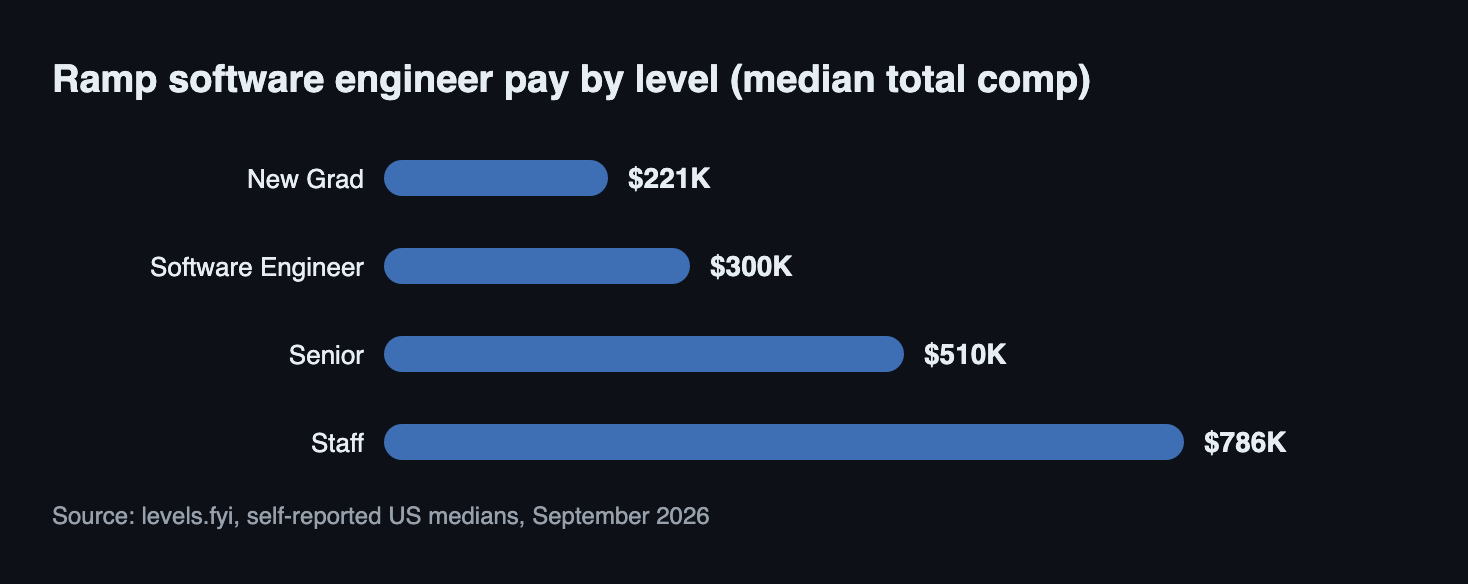
Splits, for shape: a mid-level Software Engineer median is about $200K base, $96K stock, and a small bonus; Senior runs about $235K base and $271K stock; Staff about $281K base and $505K stock with no bonus. The stock share of the package climbs steeply with level, which is the thing to understand before you compare Ramp against a public-company offer.
Three structural points:
→ Posted base ranges are wide and honest. Ramp lists pay on its job postings. The current Software Engineer, Frontend req shows a $143.2K to $284K base range plus equity, which is a two-times spread inside a single posting. Where you land in it is decided by the level the loop assigns, so the leveling conversation with your recruiter is worth having early.
→ Vesting is standard four-year, one-year cliff. 25% at the first anniversary, quarterly after that, per levels.fyi's Ramp page. No Coinbase-style annual grants here.
→ The stock is private, but it has been liquid. Ramp ran a $150 million employee-and-investor tender in March 2025 and included an employee tender in its November 2025 round. That is a better liquidity track record than most private fintechs, but it is a track record, not a guarantee. Value the equity at the preferred price if you want to be optimistic and at the 409A if you want to be careful, and ask the recruiter for both.
Ramp has no published no-negotiation stance. Candidate reports describe ordinary negotiation on level and equity, with competing offers doing the usual work.
What is Ramp actually screening for?
Builders, in the founders' own words, and specifically people they would follow.
Ramp's careers page states the hiring bar as a single question: "If this person started a company, would we join them?" The surrounding copy is consistent with it: "We only hire builders." "Build without permission." "Hands off doesn't exist at Ramp." "We're a proud meritocracy. Titles and roles are the least interesting thing." This is the culture that made "velocity" its one-word self-description, organizes product, engineering, design, and data into single teams reporting up through the CTO, and, per its VP of Product, holds that "doing is better than planning."
The hiring philosophy behind it, as Glyman and Atiyeh have described it: hire for slope, not y-intercept. Ramp has a long record of hiring engineers with one to five years of experience and promoting quickly, with some tech leads only two or three years out of school. In the behavioral round that translates into a specific kind of story: something you shipped end to end, something you did because nobody stopped you, a case where you were wrong and changed course fast. Polished leadership narratives about aligning stakeholders land worse here than a concrete account of an ugly problem you took ownership of. Our behavioral interview guide for engineers is the companion piece for building that story bank.
Two signals candidates consistently underweight. First, product sense is graded in the coding rounds, not just in a separate conversation: the "product-framed twist" on problems is a test of whether you ask what the user actually needs before you build. Second, the office is a filter. If you are lukewarm on New York, or on three-plus days a week in a room, say so early rather than late; Ramp would rather know.
One number to hold next to all of that: Glassdoor's software engineer reviewers rate Ramp's interview difficulty a moderate 3 out of 5 but only 29% describe the experience as positive. Read that as a company that moves fast and rejects without much ceremony, not as a hard loop.
Which Ramp engineering roles are open right now?
As of September 3, 2026, Ramp's careers page lists about 140 open roles, 29 of them in Engineering, all with New York as the primary location. A representative cut, with direct application links:
| Role | Focus | Location |
|---|---|---|
| Software Engineer, Core Product | Core product | New York (HQ) |
| Software Engineer, Frontend | Frontend, React | New York (HQ), SF, Remote US/Canada |
| Software Engineer, Data Platform | Data platform | New York (HQ) |
| Software Engineer, Credit | Credit systems | New York (HQ) |
| Software Engineer, Fraud & Identity | Fraud, identity | New York (HQ) |
| Software Engineer, Bill Pay & Procurement | Payments, procurement | New York (HQ), SF |
| Software Engineer, Developer API | Public API | New York (HQ) |
| Software Engineer, Security, Stablecoin | Stablecoin security | New York (HQ), SF, Remote |
| Software Engineer, Growth Platform | Growth | New York (HQ), SF |
| Software Engineer, Enterprise Product | Enterprise | SF, New York (HQ) |
| Software Engineer, Engineering Platform | Internal platform | New York (HQ) |
| Applied AI Engineer | Applied AI | New York (HQ), SF |
| Applied AI Engineer, Fullstack | Applied AI, fullstack | New York (HQ), SF |
| Software Engineer, Forward Deployed AI | Forward-deployed AI | New York (HQ) |
Also open: mobile (iOS and Android), production engineering, security (cloud, product, privacy), and a London-based international engineering role. The full board is here.
Note the shape of the list: three AI-titled engineering reqs, a stablecoin team, credit, and fraud. That is where a company that just raised $750 million to build finance agents is putting headcount. These listings churn, and fresh postings are where your odds actually live, which is exactly why ApplyIn watches for new roles matching your stack and applies the day they open rather than the week you next check the board.
How should you prep differently for Ramp?
Prep for a loop that samples the job, at a company where the job is increasingly directing systems that write the code:
→ Do the puzzle properly if you get one. The capture-the-flag gate is not hard, but it is watched. Write the small coding task the way you would write production code: clear names, a test, no dead code. It is the first artifact anyone at Ramp sees from you.
→ Practice build-a-system problems, not algorithms. Reservation systems, crawlers, in-memory file systems and ledgers, with concurrency as the follow-up. Practice in your own IDE, out loud, in 60-minute blocks. The CodeSignal progressive format rewards getting level one working cleanly before you touch level two.
→ Bring product questions into the coding rounds. Before you write anything, ask who uses this and what breaks for them. The "product-framed twist" is where Ramp separates engineers who build what was asked from engineers who build what was needed.
→ Flavor system design with spend-management reality. Card authorization at the point of sale, idempotent payment pipelines, double-entry ledgers, policy enforcement on transactions, reconciliation against bank feeds. Our system design guide for the AI era covers the format; the domain flavor is on you.
→ Have an honest answer on AI tooling. Whether or not a tool is on screen, expect to be asked how you use assistants today and where you do not trust them. At a company where the internal agent writes most merged PRs, "I don't really use them" is a worse answer than a specific account of what you delegate and what you verify.
→ Decide about New York before the recruiter call. Relocation is covered. Ambivalence is not.
→ Write six slope stories. Fast learning, ownership without permission, a reversed decision, a shipped thing you can defend line by line, per the behavioral guide.
And make sure the resume that starts all this survives parsing; the ATS-proof resume guide applies here like everywhere else, with one Ramp-specific addition: side projects and things you built without being asked are directly relevant signal for a company whose hiring question is whether it would join your startup.
FAQ
Does Ramp really make you solve a puzzle to apply?
For some engineering postings, yes. Candidates have described a capture-the-flag style gate (decode a string, find a hidden element, follow it to a short coding task) that unlocks the real application link, and solutions have circulated on LeetCode's discussion board and GitHub since 2023. Not every posting uses it. If the apply button works normally, you have not missed anything.
How long does Ramp's interview process take?
Two to four weeks from recruiter screen to offer in the common case, with team matching adding one to two weeks for some roles. That is quick for a company of Ramp's size, and it matches the company's stated preference for speed. A competing offer with a deadline will compress it further.
Is Ramp remote?
Mostly no. Ramp is headquartered in New York with offices in San Francisco and Miami. Engineering postings are listed as hybrid with New York primary; a minority carry Remote (US) or Remote (Canada) as secondary locations, and employee reviews describe an expectation of three or more days a week in the office for new hires. Relocation support to New York or San Francisco is part of the standard offer. Check the specific posting; the location field is accurate.
Can I use AI tools like Cursor or Claude Code in a Ramp interview?
Not by default. Prep sites tracking the loop describe it as not mandating AI tooling, and most reports describe standard shared-editor coding rounds. Some candidates report a team-specific AI-assisted round graded on direction and verification rather than output. Ask your recruiter for each round's setup, and prepare to be asked how you use AI tools in your own work regardless, since Ramp's engineers merge most of their code through an internal coding agent.
The honest summary: Ramp runs a fast, practical loop, sometimes gated by a puzzle, built to look like the job, at a New York company that just raised at $44 billion and expects you to show up in person. The comp is top of market and stock-heavy; the culture filter is the founders' one question about whether they would join your company. The prep is practical building, product judgment, a real answer on AI tooling, and a decision about New York. Then apply while the posting is fresh, and interview for the level you actually operate at, because the posted base ranges are wide enough that leveling is most of the negotiation.
Sources: Ramp Series F press release and TechCrunch coverage (June 2026); TechCrunch on the November 2025 round; American Banker on the co-CEO change (June 25, 2026); Ramp careers page and Ashby job postings (accessed September 3, 2026); The Pragmatic Engineer, "Why Ramp built its own in-house coding agent, Inspect" (August 25, 2026); levels.fyi Ramp software engineer page (September 3, 2026); Lenny's Newsletter, "How Ramp builds product"; Paraform, "Ramp's approach to hiring"; Glassdoor Ramp software engineer interview reviews; candidate-reported loop details via Interview Query, TechPrep, Dataford, and JobsByCulture (2026).