Career Advice
State of the Dev Job Market: Mid-2026 (H2) Update
David Eric ·

In June I wrote that the 2026 dev market didn't recover or collapse, it split: senior and AI-adjacent demand growing while the bottom of the ladder got sawed off. Ten weeks later, the fresh numbers are in. JOLTS, Challenger, Indeed's postings data, TrueUp's tracker.
This is the update, not a rewrite. What moved, what didn't, and what it changes about how you should be applying this fall.
The wider market froze in place
Start outside tech, because it sets the stage.
The June JOLTS report (released August 4) put US job openings at 7.4 million, down slightly from the 7.6 million peak I cited in the spring. Hires held at 5.3 million. Layoffs held at 1.8 million, which is historically low.
The number that matters most is quits: the quits rate sat at 2.0% for a second straight month, the lowest sustained level in roughly a decade outside the pandemic. People with jobs are not leaving them.
That's the "low-hire, low-fire" economy: nobody's getting purged, and nobody's moving. For a job seeker it means fewer vacated seats. The openings that do exist are disproportionately new roles someone chose to create and budget for, and that shapes everything below.
Tech is the loud exception
While the rest of the economy calmed down, tech kept cutting.
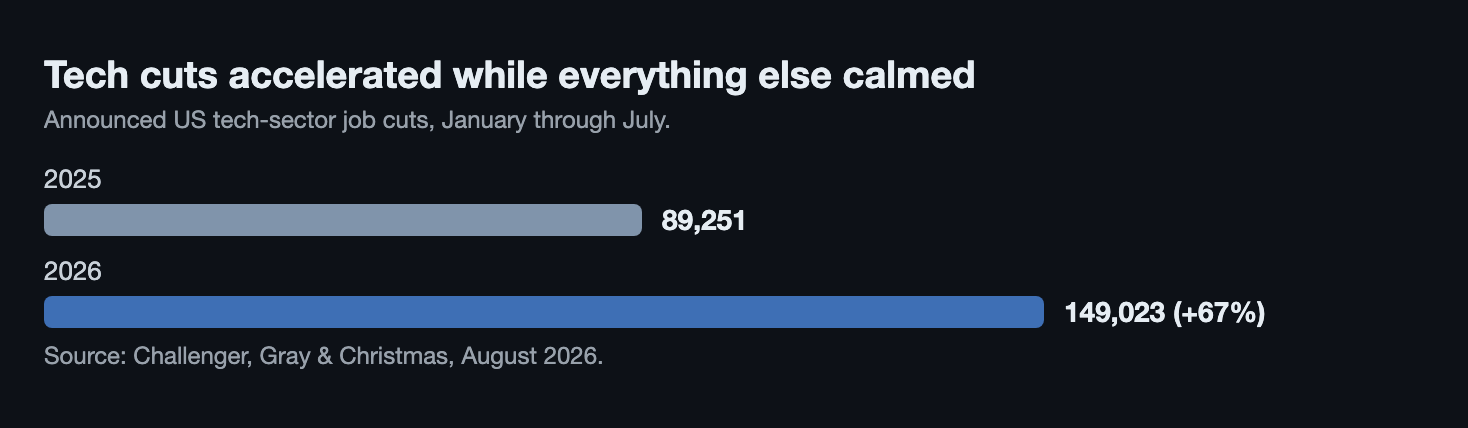
Challenger's data through July: 149,023 announced tech-sector job cuts so far in 2026, up 67% from 89,251 in the same stretch of 2025. Tech led every other sector. AI was the most-cited reason for cuts for the fifth consecutive month, and now accounts for roughly a quarter of all announced cuts this year, across all industries.
Hold that against the backdrop: total US cuts across all industries are down 41% year over year, and announced hiring plans are up 25%. The economy overall is shedding fewer people than last year. Tech is shedding a lot more. The restructuring I described in June isn't winding down; it's concentrating.
August kept the drumbeat going at smaller scale: Apple, Zillow, Etsy, and TikTok all announced cuts in the hundreds, and Netflix closed two game studios.
And yet: software postings are growing
Here's the half of the story the layoff headlines skip.
Indeed's Hiring Lab found that US software-development postings are up about 15% since early 2025, over a period when overall US postings fell 7%. Dev hiring is outgrowing the market that contains it.
But look at where the growth came from: 71% of the increase came from senior roles, and 37% from roles with AI in the title. Postings overall are still about 27% below their pre-pandemic level. TrueUp's tracker, which follows open jobs at 9,000+ tech companies and startups, showed 267,320 open tech jobs as of August 26, up 64% from the market's low but still well under the 2022 peak.
So the June thesis didn't just hold, it got more pronounced. Demand is real and growing, and it is almost entirely concentrated in senior judgment and AI capability. The bottom rung hasn't come back: there's no fresher new-grad data than the figures I cited in June (roughly 7% of Big Tech hires, under 6% at startups), and the NY Fed still has CS-grad unemployment at 6.1%, above the average for recent graduates.
The scoreboard, June vs now
| Measure | June post | Now | Read |
|---|---|---|---|
| US job openings (JOLTS) | 7.6M (April) | 7.4M (June) | Cooling, not collapsing |
| Hires (JOLTS) | 5.1M | 5.3M | Flat |
| Tech cuts, Jan–Jul (Challenger) | n/a | 149,023 vs 89,251 in 2025 | +67%, tech leads all sectors |
| Software postings (Indeed) | n/a | +15% since early 2025 | Growth is 71% senior roles |
| Open tech jobs (TrueUp) | n/a | 267,320 (Aug 26) | Up 64% from the low |
| New-grad share of Big Tech hires | ~7% | ~7% (no fresher data) | The rung is still missing |
| CS-grad unemployment (NY Fed) | 6.1% | 6.1% | Unchanged |
One number in that table deserves its own section.
The pile-up on the application side got worse
Greenhouse, the ATS that sits under a huge share of tech hiring, now counts about 254 applicants per job posting, and its recruiters are processing roughly four times the applications they were a few years ago. Greenhouse's own CEO calls the mechanism "the AI doom loop," which is word for word the thing we wrote about in July: AI applies, AI screens, and every submission makes every other submission worth less.
At 254 applicants per posting, your application's visibility decays in hours, not weeks. That's the math behind why the first 24 hours of a posting decide your odds, and the case for it is stronger now than when we published it.
What to change for a fall search
The June playbook (prove judgment before the title, direct AI rather than compete with it, follow demand into growing verticals) all still applies. The new data sharpens four things:
1. Aim at created roles, not vacated ones. With quits frozen, the openings that exist were deliberately budgeted, and 71% of the posting growth is senior. Read each posting for evidence of a real, new mandate: a named team, a specific system, an owner. Those reqs close; recycled ones often don't.
2. Put AI in your search terms, not just your resume. More than a third of new software-posting growth carries AI in the title. If your last two years touched evals, retrieval, model integration, or AI-assisted delivery in production, those words belong in your searches and your first resume line.
3. Treat speed as strategy. 254 applicants per posting means being early is worth more than being slightly better. Set up alerts on the searches that match your record and apply the day a fitting role appears.
4. Keep working the healthy corners. The senior-and-AI tilt shows up strongest in places shipping AI into regulated systems. Fintech remains one of the healthier corners of this market, and the reasoning from June hasn't changed.
The bottom line
The split didn't heal over the summer. It settled in.
Cuts up 67% and postings up 15% are both true, the same way 7.6 million openings and 52,000 Q1 cuts were both true in the spring. The market keeps paying for fewer, more senior, more AI-fluent people while the rest of the economy holds its breath. If your search strategy dates from 2024, the gap between what you're doing and what works has only widened since June.
Match your background against what's actually growing, and get there early.
Put your search on the growing side
FAQ
Is the dev job market better or worse than it was in spring 2026?
Marginally better on demand and worse on competition. Software postings grew about 15% since early 2025 even as overall US postings fell, and TrueUp counts 267,320 open tech jobs, up 64% from the trough. But tech cuts are running 67% ahead of last year and Greenhouse counts roughly 254 applicants per posting, so each opening is more contested than in spring.
Why are tech layoffs up if software postings are growing?
Because they're happening to different roles. Companies are cutting positions whose work AI tools now absorb (AI has been the most-cited layoff reason for five straight months) while adding senior and AI-focused engineering roles: 71% of the growth in software postings came from senior titles. It's one restructuring showing up as two headlines.
Is fall 2026 a bad time to switch jobs?
It's a bad time to switch casually and a workable time to switch deliberately. The 2.0% quits rate means fewer vacated seats, but it also means fewer employed engineers competing for the roles that open. If your experience matches the senior or AI-tilted postings that are actually growing, you face a thinner field than the headline numbers suggest.
Sources: US job openings, hires, and quits, BLS JOLTS (June 2026, released August 4). Tech-sector job cuts and AI as the leading cut reason, Challenger, Gray & Christmas (July 2026 report). Software-development postings and seniority mix, Indeed Hiring Lab (July 2026). Open tech jobs, TrueUp (August 26, 2026). Applicants per posting, Greenhouse via Fortune (July 2026). CS-graduate unemployment, Federal Reserve Bank of New York. August layoff roundup, Yahoo Finance (August 24, 2026). Figures move month to month; verify current numbers before relying on them.