Career Advice
System Design Interviews in the AI Era: What Still Gets Tested
David Eric ·
Almost everything.
AI tools took a wrecking ball to the coding round. Companies split into camps, one side handing candidates a Claude window inside CoderPad, the other threatening disqualification for opening one. The system design round mostly shrugged. It was never a typing test, so a tool that types faster didn't break it.
What did change is the wrapper: the medium you draw in, the prompts you get, the bar you're graded against, and whether an AI assistant is sitting in the room with you. Here's the short version, then the detail.
Still tested, at every company, AI or not: scoping the problem before you draw anything, choosing between options and defending the choice, going deep on one component when pushed, knowing how the thing fails at 3 a.m., and driving the conversation.
Changed: some loops now run design rounds in a text-diagram tool with an AI assistant available; LLM-serving prompts have moved from ML-only loops into general software engineer loops; cost and operations get graded explicitly; and the passing bar is higher because the last two years of prep material made a merely competent answer common.
Split by company: Meta, Canva, and Shopify now allow or expect AI use in technical rounds. Amazon, Cisco, and Anthropic's live rounds prohibit it. Google is doing both, piloting an AI-assisted round while also bringing back an in-person one. Check the policy for every loop, because the wrong assumption in either direction costs you the offer.
Did AI actually change the system design interview?
Less than you'd think, and the people running the interviews say so.
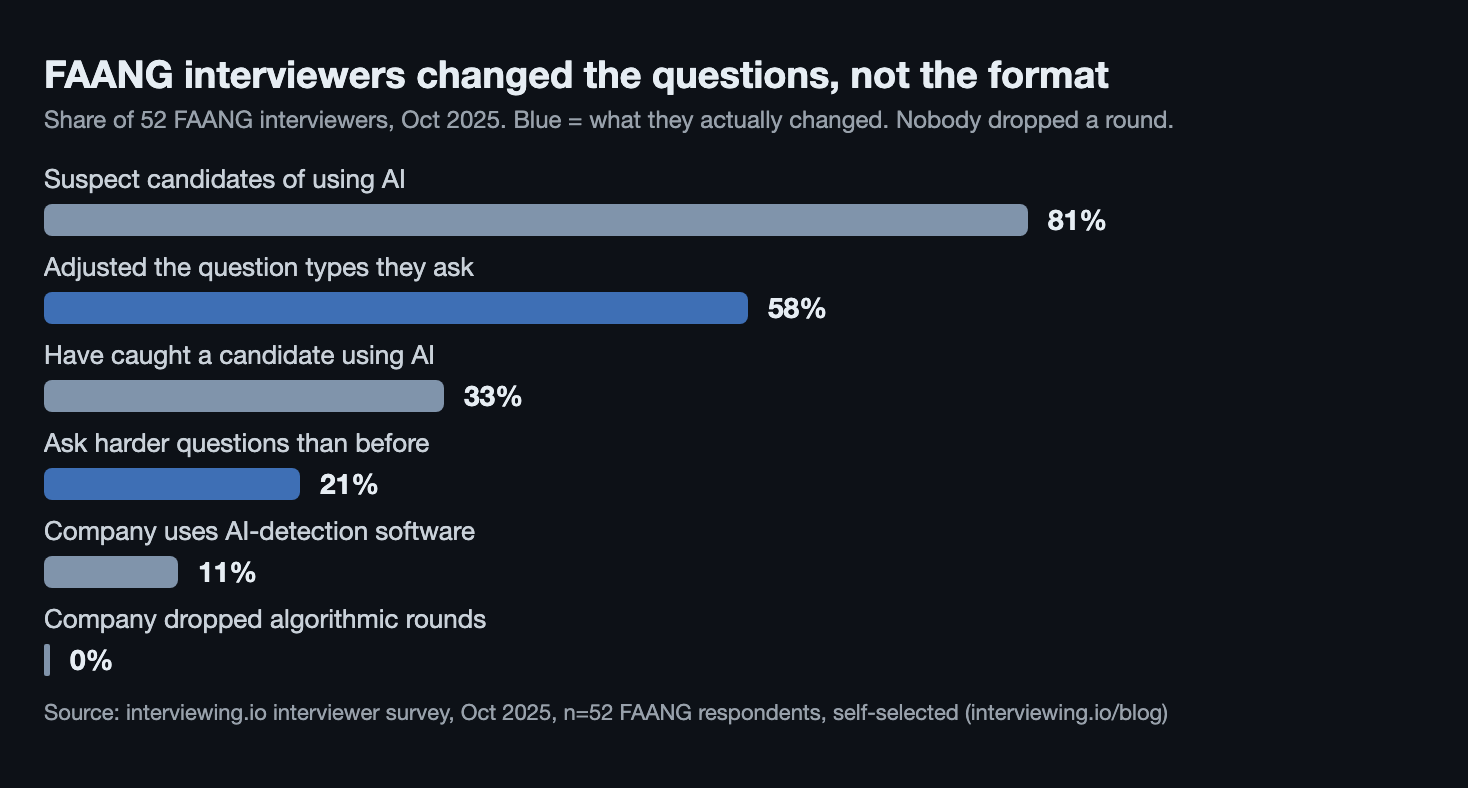
In October 2025, interviewing.io surveyed 67 technical interviewers, 52 of them at FAANG companies. Zero of the 52 said their company had moved away from algorithmic questions. What they had done was adjust: 58% changed the question types they ask, 21% ask harder questions, and half expect a return to in-person interviews. Only 11% said their company uses any AI-detection software.
The reason system design absorbed AI better than coding is structural. A coding round asks you to produce an artifact, and an LLM produces that artifact well. A design round asks you to hold a conversation about constraints, and the artifact (boxes and arrows) is the least important output. An interviewer who watches you scope a problem, pick a consistency model, and then defend it under three follow-ups has learned what they came to learn, whether or not a model drew the boxes.
That doesn't mean leaders are relaxed. Karat's January 2026 survey of 400 engineering leaders found 71% say AI is making technical skills harder to assess, and the leaders estimate over half of candidates use AI in interviews even when told not to. The industry's response has been to move weight toward the formats where using AI doesn't help much, and system design is the biggest one.
Which companies let you use AI, and which will disqualify you?
This is the part that changed most, and it's a split, not a trend. As of September 2026:
| Company | Policy in technical rounds | Source |
|---|---|---|
| Meta | AI assistant available inside CoderPad for select roles; design rounds run in CoderPad with Mermaid, same assistant | Meta Careers |
| Canva | Expects backend, ML, and frontend candidates to use Copilot, Cursor, or Claude during technical interviews | Canva Engineering, Jun 2025 |
| Shopify | Two AI-enabled coding rounds, bring your own tools | Hello Interview, Feb 2026 |
| Piloting a Gemini-assisted round for early and mid-career SWEs in H2 2026, and reintroduced at least one in-person round | Entrepreneur, May 2026; Computerworld, Aug 2025 | |
| Amazon | GenAI tools prohibited "unless explicitly permitted"; violations can mean disqualification | ITPro, Mar 2025 |
| Anthropic | Live interviews: "no AI assistance unless we indicate otherwise" | Anthropic candidate guidance, Jul 2025 |
| Cisco | "If a candidate is not explicitly invited to use AI during the assessment process, then it should be considered off-limits" | Computerworld, Aug 2025 |
Meta's is the one to study, because it's the only published policy that names the design round specifically. Its hiring-process page says design interviews "will be conducted in CoderPad with Mermaid Markdown with the same AI assistant available in the coding interview." Meta's own framing, in the prep materials it sends candidates, is that the format is "more representative of the developer environment" and "makes LLM-based cheating less effective." Both of those are true, and the second one is the tell: if the assistant is already in the room, nobody gets credit for what it produces.
The other camp is just as explicit. Amazon's internal guidance, first reported by Business Insider, tells candidates not to use GenAI tools during interviews and warns that "failure to adhere to these guidelines may result in disqualification." Cisco's head of talent acquisition drew the same line. Anthropic, which sells the assistant, tells applicants its live rounds are "all you."
And Google is the bellwether for where this lands: an AI-assisted pilot for junior and mid-level engineers, and, per the Wall Street Journal's August 2025 reporting, a reinstated in-person round so interviewers can confirm "the fundamental coding skills necessary for the roles." A Gartner figure in the same coverage: 72.4% of recruiting leaders were already interviewing in person to combat fraud. Expect more loops to look like this, tool-assisted for some rounds and tool-free, in a room, for at least one.
The practical rule: assume nothing. The recruiter's prep email will state the policy. If it doesn't, ask in writing before the round. Using AI where it's banned ends the process. Not using it where it's expected, at a place like Canva, reads as someone who hasn't worked in a modern environment.
What still gets tested, at every company
Five things. They were the rubric before Copilot and they're the rubric now, because none of them is something an assistant can do on your behalf in a 45-minute conversation.
1. Scoping before drawing. The first ten minutes are a requirements interview, and it's where most rejections are decided. Who are the users, what's the read/write ratio, what's the latency budget, what can be eventually consistent, what absolutely can't. A candidate who opens Mermaid and starts placing boxes has skipped the part the interviewer weights most. An LLM will happily produce an architecture for an underspecified problem; that's exactly why it's not a substitute for asking.
2. Tradeoffs with reasons. Not "I'd use Kafka here." Why Kafka over a simpler queue, what you give up, and what would make you change your mind. Interviewers are grading the decision process, and the fastest way to lose them is to present a choice as obvious. The Stack Overflow 2025 developer survey found more professional developers actively distrust the accuracy of AI tools (46%) than trust it (33%), and 66% are frustrated by answers that are "almost right, but not quite." An interviewer has the same instinct about candidates. Confident, generic, and slightly off is a recognizable pattern now.
3. Depth on one component. Every design round has a moment where the interviewer stops the tour and says "let's go deep on the write path." That's the test. Can you take one box and talk about its data model, its hot keys, its retry semantics, what happens under a partition, for ten minutes without hand-waving? Breadth is table stakes. Depth is the differentiator, and it can't be borrowed.
4. Failure and operations. What breaks first at 10x load. What the on-call sees when the cache cluster dies. How you'd roll out a schema change without downtime. Interview-prep firms report that cost and operations have moved from bonus points to explicit grading criteria, and that matches the broader mood: the 2025 DORA report, across roughly 5,000 respondents, found AI adoption now correlates with higher delivery throughput but still with lower delivery stability. Teams shipping more, breaking more, and hiring people who can tell them why.
5. Driving the conversation. You lead. You check in. You manage the clock. You notice when the interviewer is steering and follow. This is the softest of the five and the one candidates most consistently underweight. It's also the closest thing to what the job actually is at senior levels, which is why it's graded hardest at senior levels. Our behavioral interviews guide covers the same muscle from the other side.
If you're using an assistant in a loop that allows one, its useful role is as a checklist and a rubber duck: "what am I missing in the failure modes for this component?" Its useless role is as the author. An interviewer watching you paste an architecture and read it back has learned one thing, and it isn't good.
What changed: the medium, the prompts, and the bar
Three concrete shifts worth preparing for.
The medium. For years the design round was a physical whiteboard or a shared drawing canvas. Meta's move to CoderPad with Mermaid Markdown means some loops now expect you to describe an architecture as text that renders into a diagram. It's a different skill. Mermaid is fast once you know it and painful if you're learning it live, so if you're interviewing anywhere that might use it, spend an hour getting fluent. The same goes for narrating a design in a remote call with no shared surface at all, which more in-person-averse companies are doing.
The prompts. LLM features are now a normal thing to be asked to design in a general software engineer loop, not just an ML engineer loop. "Design a chat assistant for support," "design semantic search over internal docs," "design the serving layer for an AI feature." The shape of these is well documented; Hello Interview's Design ChatGPT breakdown treats the model as a black box and centers the real problems: token streaming, persisting a stream across reconnects, routing requests to GPU workers, rate limiting by tier, and inference cost that grows with conversation length. Notice that list. Every item is a classic distributed-systems concern with a new, expensive, slow, unpredictable component bolted on. If you can design a rate limiter and a queue, you can design this. You just have to have thought about it once before the interview.
Sundar Pichai said in April 2026 that 75% of new code at Google is now AI-generated and approved by engineers. That "approved by engineers" is the whole hiring question. The interview is trying to find the people who can do the approving, and the design round is where that shows.
The bar. Two years of excellent free prep material, plus candidates practicing with AI, mean the median design answer is better than it used to be. Interview-prep firms report the passing bar has risen accordingly, and candidates with strong rounds are getting declined at the offer stage more often. Treat that as a hedge, since nobody has published pass-rate data, but the direction is consistent with everything above: a competent, generic answer used to be enough. Now it's the floor.
How to prepare for a 2026 loop
The classic prep still works. Add these.
Find out the tool policy for each round, in writing. Ask the recruiter: is AI use permitted, in which rounds, which tools, and is any round in person? The answer changes your prep and it's a completely normal question now. If a company can't answer it, that tells you something about the loop.
Practice out loud, on a timer, with someone interrupting. The five things above are all conversational. Reading design write-ups builds knowledge; it doesn't build the ability to scope a vague prompt in eight minutes while a stranger pushes back. A friend, a mock platform, or an AI playing interviewer all work, as long as you're the one talking.
Do three deep dives, not thirty shallow ones. Pick three components you'd expect in your target roles (a ledger with strict consistency for fintech, a rate limiter, a fan-out feed, a search index) and learn one of them to the point where you could talk for fifteen minutes about its failure modes. Interviewers can tell the difference between someone who read about idempotency keys and someone who's been paged over a duplicate charge.
Add one LLM-serving design to your rotation. Streaming, queueing to GPU workers, tiered rate limits, cost per token. One evening covers it, and it's increasingly likely to come up.
If you're interviewing at fintech companies, expect the ops and consistency questions to be sharper. Payments systems have unusually unforgiving failure modes, and the Stripe and Coinbase loops both spend real time on how your design behaves when a downstream dependency is slow, wrong, or gone. Exactly-once semantics, reconciliation, and audit trails are not bonus topics there.
Keep the judgment sharp between interviews. If most of your day is approving AI output, the muscle that a design round tests is the one that atrophies first. We wrote about that in the skill the market pays more for. Design something from scratch, on paper, once a week. It's cheap insurance.
The system design round is the most honest interview left. It rewards the thing the job actually needs, it's hard to fake with a tool, and the companies that let you use the tool are mostly doing it to make the faking harder. Prepare for the conversation, not the diagram.
One last thing about timing. Every design loop starts with an application getting read, and in a market where a posting draws hundreds of applications in its first day, that's the bottleneck before the whiteboard is. ApplyIn exists to get a tailored application in during the first hours a matching engineering posting is live, so you're prepping for the loop instead of hoping to get one.
FAQ
Can I use ChatGPT or Claude in a system design interview?
Only if the company says so, and it varies by company and by round. Meta, Canva, and Shopify allow or expect AI tools in technical rounds, and Meta's design rounds run in CoderPad with an AI assistant available. Amazon, Cisco, and Anthropic prohibit AI in live interviews unless explicitly permitted, and Amazon says violations can lead to disqualification. Ask the recruiter for the written policy before every loop.
Has the system design interview changed because of AI?
The rubric hasn't. Interviewers still grade requirements scoping, tradeoff reasoning, depth on one component, failure handling, and how you drive the conversation. What changed is the medium (some loops use text-based diagram tools like Mermaid), the prompts (LLM-serving designs now appear in general engineering loops), explicit grading of cost and operations, and a higher passing bar as prep material improved.
What system design questions are being asked in 2026?
The classics are still the bulk: URL shortener variants, feeds, chat, rate limiters, payment flows, search. The new addition is AI-feature design: a support chat assistant, semantic search over documents, or the serving layer for an LLM feature. Those reduce to streaming, queueing to expensive workers, tiered rate limiting, and cost control, so the underlying distributed-systems skills carry over.
Are companies moving system design interviews back in person?
Some are. Google reintroduced at least one in-person round in 2025, McKinsey requires an in-person meeting before offers, and half of the FAANG interviewers in interviewing.io's October 2025 survey expect a return to in-person interviewing. Gartner data reported by Computerworld found 72.4% of recruiting leaders were already conducting in-person interviews to combat fraud. Prepare to draw and talk with no tools at all for at least one round.