Career Advice
Behavioral Interviews for Engineers: Prep Without Sounding Rehearsed
Adam Ross ·

There are two ways engineers lose behavioral interviews. The first is treating the round as HR theater: wing it, ramble through "a time you faced a challenge," and trust the coding rounds to carry you. The second is the opposite failure: scripting six STAR stories word for word, then delivering them with the frictionless fluency of a conference talk you've given forty times.
Both lose for the same reason. The interviewer isn't grading your story. They're grading what happens when they poke at it.
This guide is the working engineer's version of behavioral prep: what the round actually measures, why it counts for more in 2026 than it ever has, the six stories that cover nearly every prompt, and a prep method that makes you sound like someone who lived the work instead of someone who memorized it.
Why do behavioral rounds matter more in 2026?
Because they're the one part of the loop AI hasn't hollowed out, and companies are leaning on them accordingly.
The Wall Street Journal reported in August 2025 that Google, Cisco, and McKinsey have all reinstated in-person interview rounds, largely because AI made remote screens unreliable. Google now requires at least one in-person round; McKinsey asks hiring managers to schedule at least one face-to-face meeting. The remote coding screen, where a candidate can feed every prompt to a model off-screen, stopped being trusted evidence of anything.
The scale of the trust problem is measurable. In a Gartner survey of 3,000 job candidates in mid-2025, 6% admitted to participating in interview fraud, either posing as someone else or having someone pose as them. Gartner's projection is that by 2028, one in four candidate profiles worldwide could be fake.
So the live, probing conversation about work you've actually done is being asked to carry the weight the take-home and the screen used to carry. Companies were already interviewing more, not less: Gem's 2025 benchmarks, drawn from 140 million applications, show hiring teams now conduct about 20 interviews for every hire they make, up 42% since 2021. When you finally get a loop, the behavioral rounds are where the decision increasingly gets made.
What are interviewers actually grading?
At any company running a competent process: your answers against a rubric, not your charisma.
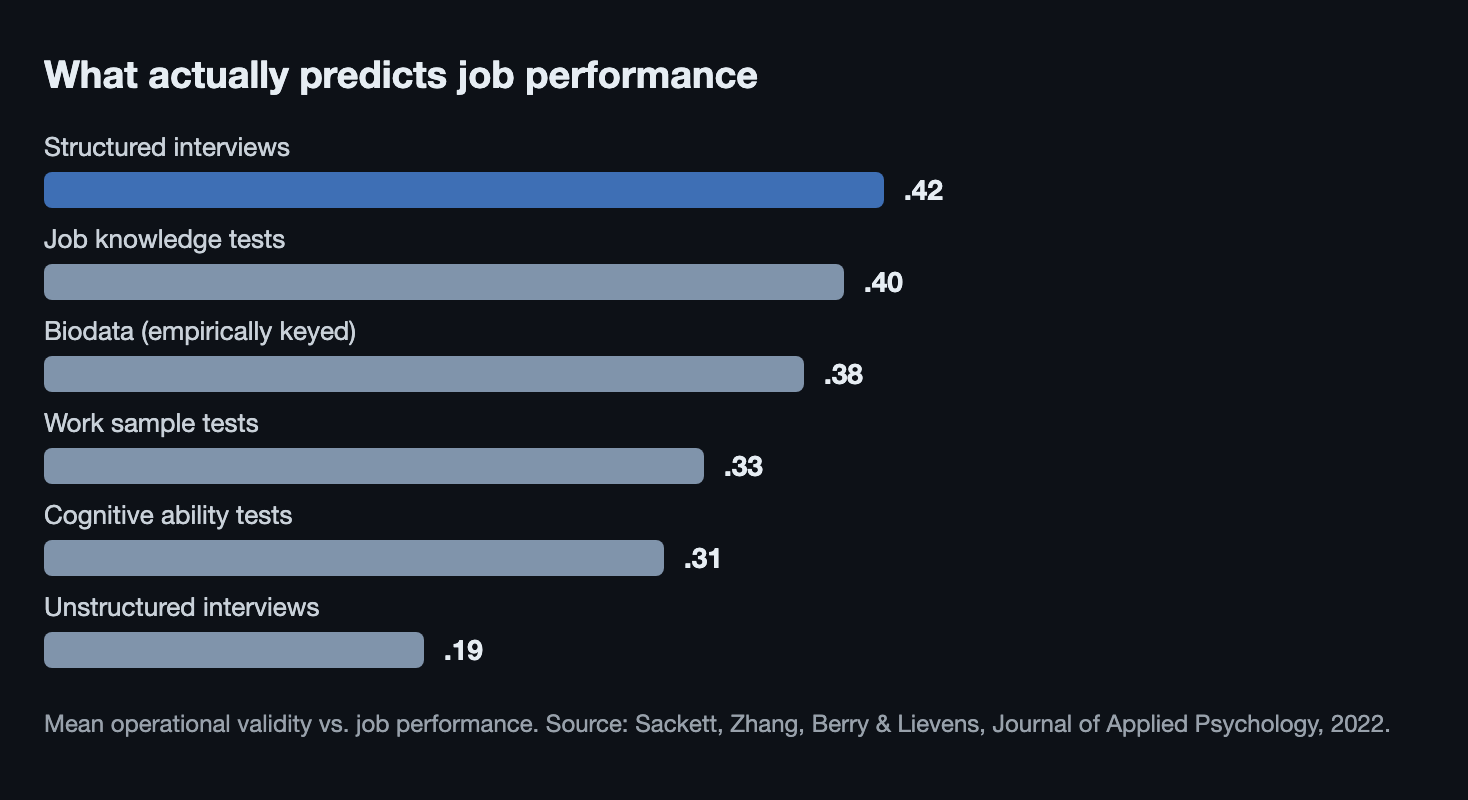
The research here is unusually one-sided. A 2022 meta-analysis by Sackett, Zhang, Berry, and Lievens in the Journal of Applied Psychology re-estimated the predictive validity of every common hiring method, and structured interviews came out on top of everything, including cognitive ability tests and work samples. The same interview without structure, the "tell me about yourself" ramble, sits at less than half the predictive power, tied with personality scores.
Google figured this out from its own data more than a decade ago. "On the hiring side, we found that brainteasers are a complete waste of time," Laszlo Bock, then Google's HR chief, told The New York Times in 2013. "What works well are structured behavioral interviews, where you have a consistent rubric for how you assess people." Google's internal analysis of five years of interview data, later reported by CNBC, also produced the "rule of four": four interviews were enough to predict a hire with 86% confidence.
Practically, structure means your interviewer is asking every candidate the same questions and scoring answers against defined dimensions: ownership, technical judgment, collaboration, handling conflict, learning from failure. Notice what's not on that list. Delivery polish isn't a rubric dimension. Evidence is. The whole game is giving the interviewer scorable evidence, and that changes what preparation should even mean.
Why does sounding rehearsed backfire?
Because the scripted monologue answers the first question, and the interview is the follow-ups.
A structured interviewer is trained to drill: What did the rollback cost? Who disagreed with you? What did your tech lead say when you pushed back? What would you do differently? A story you lived compresses and expands on demand; you can zoom into the metric, the Slack thread, the specific config change. A story you memorized has exactly one resolution, and the second question off-script produces the pause everyone in the room recognizes.
There's a 2026-specific version of this problem. Interviewers now read AI-polished resumes all day and sit through answers that were generated, rehearsed, and delivered on cadence. Recruiters and hiring managers are actively screening for coached, canned responses, because canned is now a proxy for "possibly not their own work." A generically perfect STAR answer, all situation and result with no texture, pattern-matches to the slop they're trying to filter out. The irony is real: over-rehearsing now makes you look less credible, not more.
The signal that survives probing is specificity. Numbers, names of systems, the trade-off you argued about, the part you got wrong. That can't be faked on the fly, which is exactly why the round is weighted the way it is.
Which stories should an engineer actually prepare?
Not answers to forty question prompts. Six to eight real stories, chosen so that every prompt maps onto one of them.
For working engineers, these six cover nearly everything an interviewer can ask:
→ The production incident you owned. Paged at 2 a.m., bad deploy, data issue. Covers ownership, calm under pressure, debugging judgment, and postmortem honesty.
→ The tech-debt call. A time you argued to pay debt down, or consciously took it on to ship. This is a judgment story: the rubric wants to see you weighing cost against speed, not reciting principles.
→ The disagreement with a senior engineer. Architecture, library choice, code review standoff. They're probing how you disagree: with evidence and a decision process, or with volume. Have one where you turned out to be wrong; it's the strongest version.
→ The project that failed or got killed. Cancelled migration, feature that shipped and flopped. The grading dimension is what you learned and what you changed, not the failure itself.
→ The time you unblocked or mentored someone. Onboarding a junior, untangling another team's blocker, documentation nobody asked you to write. Collaboration evidence, and most engineers under-prepare it.
→ The scope cut under deadline. What you dropped, how you got stakeholders to agree, what happened to the dropped half. Prioritization and communication in one story.
One story serves multiple prompts. The incident story answers "tell me about a time you were under pressure," "a hard technical problem," and "a mistake you made," depending on which thread you pull. That's the point of a story bank: eight stories, indexed by dimension, beat forty scripted answers you can't maintain.
How do you prep the stories without memorizing a script?
Prepare bullets, not prose. The difference between prepared and rehearsed is whether you wrote a script.
→ Five bullets per story, never sentences. Stakes, the decision you made, what you actually did, the measurable result, what you'd do differently. If you write full paragraphs you will recite them, and it will sound like it.
→ Compress the setup. Two sentences of context, maximum, then get to the decision. Engineers lose interviews narrating architecture diagrams for four minutes before anything happens. The interviewer will ask for context they're missing; that's what the conversation is for.
→ Land the first pass in about 90 seconds, then stop. Ending with something like "happy to go deeper on the rollback or the postmortem" hands the interviewer the drill-down, which is the part of the interview that actually scores.
→ Rehearse the follow-ups, not the monologue. For each story, drill the three questions you'd least like to be asked: what it cost, who pushed back, what you got wrong. If you can answer those cold, the top-level answer takes care of itself.
→ Practice out loud, from different entry points, in different words each time. Tell the incident story once starting from the page, once from the postmortem, once from the metric. Same facts, new sentences. That variation is what "natural" is.
Total cost: a few focused evenings. That's the time a job search is supposed to leave you, and it's the entire reason we built ApplyIn to handle the application grind, so your hours go to the rounds that are graded live instead of into stale postings that were decided before you arrived.
One more 2026 note: if you're interviewing at fintech companies, expect the behavioral bar to run higher than average. You're describing judgment calls in systems that move money, and "how did you verify it was safe" follow-ups come standard.
FAQ
Should I still use the STAR method?
As a checklist, yes. As a delivery format, no. Situation, Task, Action, Result is a fine test that a story is complete, so run your bullets through it once while prepping. But an interviewer should never be able to hear the headings. If your answer sounds like four labeled sections, you've rehearsed the container instead of knowing the contents.
How many stories do I need?
Six to eight, indexed by dimension rather than by question. Before each loop, re-read the job description and check you have coverage for what this team will care about: an infra role leans on the incident and debt stories, a senior role on the disagreement and mentoring ones. Swap stories per company; never invent new ones the night before.
What if I'm early-career and don't have production incidents?
Scale the stories down, not the honesty. A broken deployment in an internship, a group project where a teammate ghosted, a bug you shipped in a side project and had to unwind. Interviewers grade the judgment loop, decision, action, lesson, not the blast radius. A specific small story with real texture beats an inflated big one every time, and inflation is precisely what the follow-ups are built to catch.
Can I use AI to prep for behavioral interviews?
Use it as a sparring partner, not a ghostwriter. Feeding it your resume and asking for the hardest follow-up questions per story is a genuinely good drill; so is a mock interview where you answer out loud. What fails is having it write answers: model-written stories converge on the same polished, textureless shape, and screening that shape out is now part of the interviewer's job. The prep only works if the words are disposable and the facts are yours.
The reframe worth keeping: a behavioral interview is not a performance with a script to nail. It's a conversation about decisions you already made, and you're the only person in the room who was there. Prep is retrieval, not theater: pick the eight stories, know them from every angle, and let the sentences be new each time. Rehearse the facts, never the lines.