Career Advice
Startup vs Enterprise for Engineers: Which Ladder Survives AI?
David Eric ·

Neither ladder survived intact. They lost different rungs.
The usual framing of this question is about temperament: do you want the structure, comp, and brand of a large company, or the scope, speed, and equity lottery of a small one? That framing is twenty years old and it is now wrong, because AI changed the shape of both ladders in ways that matter more than your personality does. Enterprise engineering lost its bottom rungs and is now removing rungs from the middle. Startups lost the bottom rung entirely and got wider at every level above it.
So the real question is not "startup or enterprise." It is "where on the ladder are you standing, and which ladder still has a rung at that height." This is the decision guide, with the numbers.
What did AI actually do to each ladder?
It made the entry rung uneconomic everywhere, and then the two kinds of company responded differently to everything above it.
The cleanest before-and-after comes from SignalFire's June 2026 talent report, which tracks hiring across Big Tech and early-stage startups against a 2019 baseline. Three comparisons tell the whole story:
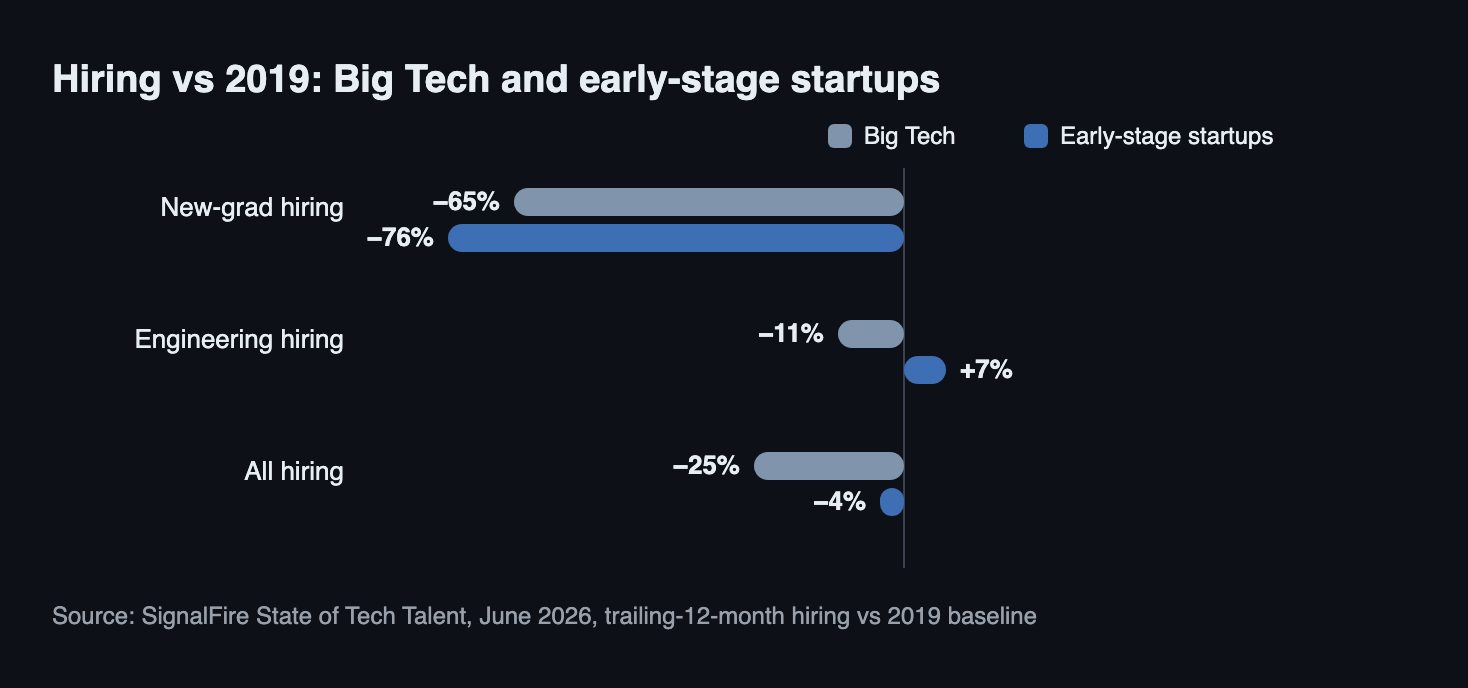
Read the three rows together. New-grad hiring is down 65% at Big Tech and 76% at early-stage startups. The startup cut is worse, which surprises people who assume small companies are where you go to get a chance. Engineering hiring overall is down 11% at Big Tech and up 7% at startups. And all hiring is 25% below 2019 at Big Tech versus 4% below at startups. Startups are hiring roughly as many people as they did in 2019. They are just not hiring juniors.
This matches what the broader labor data shows. Stanford's Digital Economy Lab, using ADP payroll records covering millions of workers, found that employment of 22-to-25-year-olds in the most AI-exposed occupations fell about 11% between November 2022 and June 2026, while the same age group in the least-exposed occupations grew about 10%. Experienced workers in the same exposed jobs show no comparable gap. That is the mechanism in one sentence: AI removed the seat where you learned the job by doing the routine version of it, and left the seats where you already know it. We wrote about the industry-wide version of this in how AI broke the junior developer ladder. This post is about what it means for the choice between two kinds of employer.
Why is the enterprise ladder losing rungs from the middle?
Because flat organizations are the explicit goal of the 2026 layoff cycle, and each removed layer is a title somebody used to get promoted into.
The bottom-rung story at large companies is well known by now: new grads went from 15% of Big Tech hires before the pandemic to about 7%. The less-discussed change is above it. When Uber cut 3,300 jobs in September, the memo did not describe a hiring freeze. It described a reshaping: the number of employees sitting seven or more layers below the CEO cut by 20%, teams with one or two reports cut nearly in half, total manager count down 20%. Oracle's annual filing in June showed it had shed about 21,000 people over the year, 13% of the company, while borrowing to build AI data centers. Amazon cut 16,000 corporate roles in the first quarter alone.
The enterprise ladder was built on layers. Engineer, senior, staff, principal on one track; lead, manager, senior manager, director on the other; each rung a title with a comp band, a promotion packet, and a calibration cycle. Every layer a company removes is a rung that no longer exists to be promoted into. The senior engineers who remain get more scope and more direct reports, and the mid-level engineer who was two years from a lead role finds the lead role has been folded into someone else's.
What the enterprise ladder still has going for it is real and worth stating plainly. The comp bands are published and the top of the curve is still the highest in the market; our Big Tech versus fintech comparison has the current numbers. The promotion process, when it exists, is legible: you know what a senior engineer is expected to do. And the structured entry programs that survive, at banks, large fintechs, and a few tech majors, are among the last places an engineer with no track record can be paid to learn. There are fewer of those programs, but they are the one part of the enterprise ladder that still has a bottom rung.
Why is the startup ladder getting wider but not longer?
Because a small team with AI tooling now does the work that used to require a bigger team, so each engineer owns more of the system, and there is no seat left for someone who cannot yet own anything.
The clearest example is the company that built the tooling. Cursor's maker reported $3 billion in annualized revenue by May 2026 with a team that stood at a little over 300 people the previous November. Whatever you think of that business, the ratio is the point: revenue per person an order of magnitude beyond what a 2019 software company would plan for. The pattern shows up at smaller scale everywhere in the early-stage market, and it explains the SignalFire numbers. Startups are hiring engineers, at a rate slightly above 2019, but they are hiring people who can be handed a system on day one, direct AI tools against it, and be trusted with the result.
That is a wider rung, not a longer ladder. A mid-level engineer at a forty-person company in 2026 typically owns what a senior engineer plus two juniors owned in 2019. The scope arrives faster and the title inflation that goes with it is real. What does not arrive is the apprenticeship. SignalFire's data has new grads at under 6% of startup hires, and the same report found top computer science graduates in 2025 twice as likely to call themselves a founder as the class of 2022, and 45% less likely to land at Big Tech. The bottom of the startup ladder has become "start the company" rather than "join it as the junior."
The startup ladder's honest downside is not layoffs in the enterprise sense. It is disappearance. Carta's shutdown data has 74% of startup closures happening at pre-seed or seed stage, and the 2021 vintage of companies produced a wave of failures that peaked through 2024 and 2025. A rung that is wide and well-paid is still gone the day the company is.
Which ladder should you climb, by where you are standing?
Pick by career stage, not by temperament. The answer is different at each height.
| Enterprise | Startup | |
|---|---|---|
| Bottom rung (0 to 2 years) | Mostly gone; survives in structured programs at banks and large fintechs | Gone; new grads under 6% of hires |
| Middle rungs (3 to 7 years) | Being removed by de-layering; fewer titles to grow into | Widest rung on either ladder; scope arrives early |
| Top rungs (staff and above) | Intact and highest-paid; reorg risk is the price | Intact; comp matches at senior, thins above |
| What gets you promoted | Calibration cycle, packet, visible impact within a defined level | Owning a system end to end and being trusted with the next one |
| Main risk | Layer removal, reorg, being the mid-level seat that gets folded | Shutdown; 74% of closures at seed or earlier |
| AI leverage per engineer | Constrained by process and review layers | Maximal; the whole point of the small team |
| Learning model | Apprenticeship where programs still exist | Self-directed, or none |
Three readings of that table:
If you have zero to two years. The startup ladder is not built for you this year, and the numbers are blunt about it. Your best odds are the structured programs that still exist at large, regulated employers, and then a lateral move once you have a system you can point to. That is the least glamorous advice in this post and it is the one the data supports hardest. The exception is the founder route, which the top of the class is increasingly taking, and which is a different bet with a different risk profile. If you do go the startup route early, go with proof of judgment in hand: something shipped, with a write-up of the decisions, because there will be no junior work to earn your keep on.
If you have three to seven years. This is the group the question is really about, and the answer has shifted toward startups for the first time in a decade. The enterprise middle is where the layers are being removed, which means the rung you were climbing toward may not be there when you arrive. The startup middle is where scope is being handed out fastest, and where the AI-tooling leverage is largest because nothing sits between you and the system. The trade is stability for scope. If you can carry twelve to eighteen months of runway risk, the scope is worth more than it has ever been, and it compounds: the engineer who owned a payments system at a 40-person company interviews as a senior everywhere.
If you are staff or above. Both ladders survive at your height and the choice reverts to the old one: the enterprise top of the comp curve against startup equity and scope. The 2026-specific note is that enterprise reorg risk is concentrated in the layers below you, which makes your seat more secure but your team less stable, while startup senior seats are the one category of engineering hiring that is actually growing.
Avoid regardless of level: joining a large company for the ladder alone. The ladder is the thing being dismantled. Join for the comp, the problem, or the program, with clear eyes about how many rungs are left above you.
The part that is true on both ladders
The skill that survives is the same on either side: the ability to take an ambiguous problem, direct AI tools against it, and vouch for the result. That is the job the enterprise senior engineer now does across a wider team, and the job the startup engineer does across a whole system. It is the reason experienced workers show no employment gap in the Stanford data while their younger colleagues show a 19% one. We argued in the AI skill-atrophy piece that the market is paying more for that judgment, not less, and the ladder data is the same story from the employer's side.
Which means the practical move, at any stage, is to build evidence of that skill on purpose, then point your applications where a rung exists at your height. The fall 2026 market report covers where the openings are growing. The first-24-hours data covers why timing matters more than volume once you have picked a target. hirecomb exists for that last step: it watches for new postings that match your stack, tailors and sends the application the morning a role opens, and tracks what comes back, so the hours you have go into the proof of judgment instead of the queue.
FAQ
Are startups better than big companies for new grad software engineers in 2026?
Statistically, no. SignalFire's June 2026 report has new-grad hiring down 76% at early-stage startups against 2019, worse than Big Tech's 65% decline, and new grads under 6% of startup hires. The structured entry programs that survive at banks and large fintechs are the most reliable bottom rung left. A startup can work for a new grad who arrives with a shipped project and a written account of the decisions in it, but there is no apprenticeship waiting.
Is it safer to be a mid-level engineer at a startup or an enterprise right now?
Different risks, not a safer one. Enterprise mid-level seats are exposed to de-layering: Uber's 2026 restructuring cut employees seven or more layers below the CEO by 20% and halved its smallest teams, and that pattern is the shape of the year's Big Tech cuts. Startup mid-level seats are exposed to the company itself failing, with 74% of shutdowns at seed or earlier per Carta. Enterprise risk is losing the rung above you. Startup risk is losing the ladder.
Does AI make small engineering teams more competitive than large ones?
At the level of output per engineer, yes, and the market data reflects it: startup engineering hiring is up 7% from 2019 while Big Tech's is down 11%, and companies like Cursor's maker reached billions in annualized revenue with a few hundred people. The advantage is leverage per engineer, which is largest when there are no review layers between the engineer and the system. It is not an advantage for the engineer who still needs those layers to learn from.
What skill matters most for engineers on either career path in the AI era?
Judgment: scoping an ambiguous problem, directing AI tools to a working solution, and being able to vouch for the result in production. Stanford's ADP data shows experienced workers in AI-exposed jobs with no employment gap while 22-to-25-year-olds show a 19% one, which is the same skill measured from the outside. Build evidence of it deliberately: real systems, real decisions, written up.
The honest summary: AI removed the bottom rung from both ladders, is removing middle rungs from the enterprise one, and made the startup one wider at every height that remains. New grads should take the structured programs that still exist. Mid-level engineers should take the scope while it is being handed out. Senior engineers can pick either and should read the reorg map before they do. Nobody should join a company for its ladder.
Sources: SignalFire, State of Tech Talent Report (June 22, 2026), trailing-12-month hiring versus 2019 for Big Tech and early-stage startups; Stanford Digital Economy Lab, "Canaries in the Coal Mine" update (August 12, 2026), ADP payroll data on 22-to-25-year-olds in AI-exposed occupations; Uber restructuring memo as reported in the 2026 tech layoff trackers (Yahoo Tech, TechCrunch); Oracle FY2026 annual filing (June 2026) and Q1 2026 layoff tallies; Carta startup shutdown data (2024 to 2025); Cursor annualized revenue and headcount via TechCrunch and the company's November 2025 funding announcement.