Career Advice
Is the Dev Job Market Recovering? What the Data Says (Fall 2026)
David Eric ·

Short answer: yes, if you're senior or work near AI. No, if you're trying to get in at the bottom. And either way, each opening is more crowded than the word "recovery" suggests.
That's not hedging. It's what the fall numbers show when you put the hiring data and the layoff data on the same page, which almost nobody does. The headlines pick one: "software postings rebound" or "2026 layoffs pass last year's total." Both ran within days of each other. Both are accurate.
This post is the data check. Fresh JOLTS (released September 1), Indeed's August postings data, the layoff trackers, and what it all means if you're applying this fall. For the full thesis on how the market got here, start with the June state-of-the-market report and the mid-2026 update; this piece answers one question with the newest numbers.
The recovery is real
Four numbers make the yes case.
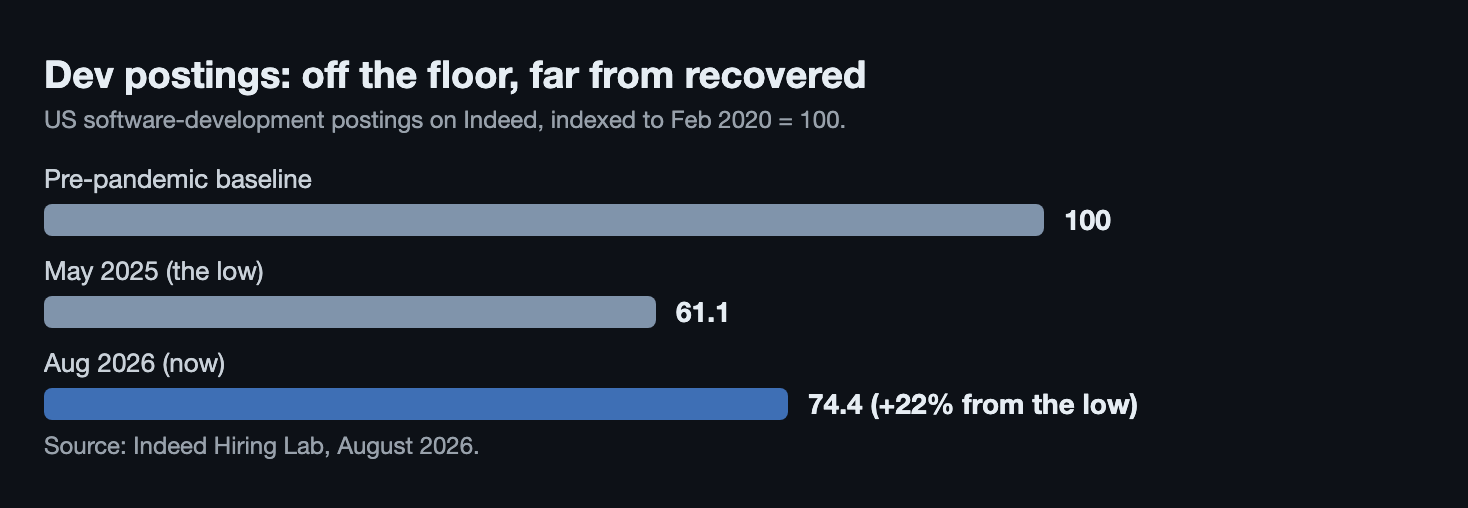
Software postings are up 22% from the bottom. Indeed's Hiring Lab puts US software-development postings at 74.4 on its index as of mid-August, up from a low of 61.1 in May 2025. That's five quarters of climbing, not a blip.
Open tech jobs are up 64% from the trough. TrueUp, which tracks openings at 9,000+ tech companies and startups, counted about 267,000 open tech jobs in late August, up 64% from the market's low.
The broader market is stable, not shrinking. The July JOLTS report (released September 1) shows 7.3 million US job openings, hires steady at 5.1 million, and layoffs at 1.7 million, which is historically low. There's still about 1.1 openings per unemployed jobseeker.
The long-run demand story didn't break. The BLS still projects software developer employment to grow 15% from 2024 to 2034, roughly five times the all-occupation average.
So the floor held, demand for developers is growing again, and the profession isn't dying. If that's all "recovery" means, the answer is yes.
What hasn't recovered
Now the other page of the ledger.
Layoffs already beat last year, with a third of the year left. Layoffs.fyi counts 123,305 tech workers cut in 2026 so far, across 289 companies. All of 2025 produced 122,606. Challenger's tally through July has tech cuts up 67% year over year, leading every sector, at 31% of all announced US job cuts. AI has been the most-cited reason for months.
The postings hole is still deep. That 74.4 index reading means dev postings sit 26% below February 2020 while the overall labor market sits slightly above it. The recovery has retraced about a third of the fall. Nobody hiring in 2019 would call this normal.
The bottom rung is still missing. The NY Fed has recent CS-grad unemployment at 6.1% (computer engineering at 7.5%), worse than the average recent graduate. New grads remain around 7% of Big Tech hires, half their pre-pandemic share. The postings growth is overwhelmingly senior: in Indeed's data, roughly 71% of the software-posting increase came from senior roles.
Nobody is vacating a seat. The quits rate has been stuck at 2.0% for months, the lowest sustained level in a decade outside the pandemic. With sitting engineers frozen in place, nearly every real opening is a deliberately created role, not a backfill, and each one draws a crowd: Greenhouse counts roughly 254 applicants per posting.
The fall 2026 scoreboard
| Measure | Latest reading | Recovery verdict |
|---|---|---|
| Software postings (Indeed) | 74.4 vs 61.1 low, still 26% below pre-pandemic | Recovering, partially |
| Open tech jobs (TrueUp) | ~267,000, up 64% from trough | Recovering, partially |
| US openings (JOLTS, July) | 7.3M, hires flat at 5.1M | Stable |
| Tech layoffs YTD (Layoffs.fyi) | 123,305, already past 2025's full-year total | Not recovering |
| CS-grad unemployment (NY Fed) | 6.1%, above the recent-grad average | Not recovering |
| Quits rate | 2.0%, decade-low territory | Frozen |
| Applicants per posting (Greenhouse) | ~254 | Worse |
Read the two "partially" rows next to the two "not recovering" rows and the shape is clear: this is a recovery in demand for experienced engineers happening inside an ongoing restructuring of everyone else.
Oracle is the whole fall market in one company
If that sounds abstract, look at the company defining tech's autumn.
Oracle cut its headcount by about 21,000 people, 13%, in the fiscal year ending May 2026, took $1.8 billion in restructuring charges, and spent the summer with new layoff dates leaking to employees while it borrowed tens of billions to build AI data centers. Cutting at record pace and investing at record pace, simultaneously, for the same reason.
That's the pattern across the sector, and it's why "is the market recovering?" has no single answer. Companies aren't deciding between shrinking and growing. They're shrinking one workforce and growing a different one, and the AI-applies-AI-screens loop sits between you and both.
What this means for a fall application strategy
The data points to four practical conclusions.
1. Take the recovery seriously in your targeting. Postings up 22% from the low means there are meaningfully more real openings than a year ago. If you paused your search in 2025 because "nothing was out there," that read is stale. The openings exist; they're senior-tilted and AI-tilted, so aim where the growth is.
2. Assume every posting is contested and act on recency. At ~254 applicants per posting and openings decaying in hours, the first 24 hours of a posting are worth more than ever. Alerts plus same-day applications beat weekend batch sessions.
3. Filter harder for real reqs. A frozen quits rate means fewer backfills and more recycled or speculative listings. Learn the tells of a ghost job before you spend an application on one.
4. Fish where the recovery is concentrated. The healthiest demand remains AI-adjacent work and the verticals shipping AI into regulated systems. Fintech is still one of the stronger corners of this market, and the fall data hasn't changed that.
The bottom line
Is the dev job market recovering in fall 2026? Demand: yes, selectively, and from a deep hole. Layoffs: no, they're running ahead of last year. Entry level: no, the rung is still missing. Competition: worse than during the downturn, because everyone and their AI is applying to the openings that do exist.
A selective recovery rewards selective applicants. Match your background to the postings that are actually growing, get there the day they open, and skip the reqs that were never real.
Apply where the recovery actually is
FAQ
Is the tech job market getting better or worse in late 2026?
Both, in different places. Demand is getting better: software postings on Indeed are up about 22% from their May 2025 low and TrueUp counts ~267,000 open tech jobs, up 64% from the trough. Conditions around that demand are getting worse: 2026 tech layoffs (123,305 by early September) have already passed 2025's full-year total, and each posting now draws roughly 254 applicants. More jobs, and more competition for each one.
Will the dev job market fully recover in 2027?
Full recovery to 2021-2022 posting levels is not what the current data projects. Dev postings would need to climb another ~34% just to reach their pre-pandemic baseline, and the roles being added are different from the roles that were cut: senior-heavy and AI-heavy. The BLS still projects 15% growth in software developer employment through 2034, so the likelier path is continued growth in a reshaped market rather than a return to the old one.
Is fall 2026 a good time to apply for software engineering jobs?
Better than any point since early 2025 if your experience matches what's growing. Openings are up meaningfully from the low, and the frozen 2.0% quits rate means fewer employed engineers are competing for them. The catch is speed: with ~254 applicants per posting, applying within the first day of a posting going live matters more than perfecting your hundredth cover letter.
Sources: US job openings, hires, layoffs, and quits, BLS JOLTS (July 2026, released September 1). Software-development and overall postings index, Indeed Hiring Lab US Labor Market Snapshot (August 2026). 2026 layoff totals, Layoffs.fyi (early September 2026). Tech-sector cut totals and AI as leading reason, Challenger, Gray & Christmas (July 2026 report). Open tech jobs, TrueUp (late August 2026). CS-graduate unemployment, Federal Reserve Bank of New York. Applicants per posting, Greenhouse via Fortune. Oracle headcount and restructuring, Oracle FY2026 filings via Quartz. Developer employment projection, BLS Occupational Outlook. Figures move month to month; verify current numbers before relying on them.