Career Advice
Robinhood Software Engineer Interview Guide (2026)
David Eric ·

Robinhood laid off about 290 people in June to raise what its CEO called the "absolute elite performance bar." Then it kept 54 engineering reqs open.
The June 16 cut took roughly 10% of a workforce of about 2,900 and closed "a small number of open roles." Vlad Tenev's framing: a "lean, hyper-focused team," done "from a position of business strength." The strength part is not spin. Six weeks later Robinhood reported second-quarter revenue of $1.31 billion, up 32%, and a 57% adjusted EBITDA margin. And three months before the cut, on the a16z podcast, Tenev said "there will be more software engineers in 10 years than there are today."
Both things are true, and together they describe the seat you're interviewing for. Robinhood is hiring fewer engineers, paying each one for the output of several, and running a loop built to find people who can carry a trading system through its worst hour. As of September 18, 2026, the job board lists 155 open roles, 54 of them individual-contributor software, ML, and security engineering, in Menlo Park, New York, Bellevue, Toronto, Denver, London, and Ljubljana. None remote.
This guide covers the whole process: the loop stage by stage, verified pay, the design round every senior candidate reports, what the seven values screen for, and the roles open now. Same honesty note as our Plaid and Ramp guides: Robinhood does not publish an interview-format page, so the loop below comes from candidate reports cross-checked against Robinhood's postings, filings, and public statements. Where a detail rests on a few reports rather than a company statement, we say so.
Why is Robinhood a target for engineers in 2026?
Because it's the rare fintech that is public, profitable, growing at 30%-plus, and shipping a new product line every quarter, and because the stock has made the equity worth reading closely.
The numbers from the July 29 second-quarter report: net revenue $1.31 billion, up 32% year over year; transaction revenue $776 million, up 44%, with event contracts (prediction markets) at $156 million, up more than tenfold, and options at $342 million; net income $573 million, up 48%, including a $129 million gain from deconsolidating a ventures fund; adjusted EBITDA $741 million at a 57% margin. Full-year 2026 expense guidance was lowered to $2.675 to $2.775 billion even as new initiatives launched. The market values the company at roughly $100 billion as of mid-September, per MacroTrends' September 14 reading of $102.8 billion.
The product surface is what you'll be interviewed on, and it's wide. In the second quarter alone Robinhood launched agentic trading (customers build AI agents to trade stocks and options, with more than 100,000 active accounts using it within the quarter), took Robinhood Chain to mainnet, expanded stock tokens to more than 120 countries, redesigned the Platinum card, and disclosed that Robinhood Legend, its desktop platform, passed $100 million in annual run-rate revenue. The open reqs map onto that list almost exactly: Tokenization, Wallet, Web3, Event Contracts, Crypto Trading, Command Center, plus the platform teams underneath them.
Three facts to hold next to that before you value an offer. First, Robinhood has cut staff three times: about 9% in April 2022, 23% in August 2022 (Tenev: "this is on me"), and 10% in June 2026. The 2022 cuts followed a revenue collapse; the 2026 one came with record results, which is a different signal and, for a candidate, a sharper one. Second, Robinhood is an in-office company again. Tenev declared it "remote-first" in January 2022 and told the Cheeky Pint podcast in August 2025 that he regretted it "pretty much immediately": "Everyone said it was a one-way door, but it turns out it's a two-way door." The current policy is three days a week for individual contributors, four for managers, five for executives, and every engineering posting we opened says "in-person attendance expected at least 3 days per week." Third, the company's own description of the engineering job has changed. In July 2025 Tenev told 20VC that "over 50% of new code at Robinhood is AI-generated," that "close to 100%" of engineers use AI editors, and that "it's hard to even determine what the human-generated code is. If I had to guess, it's in the minority."
Structurally: headquarters at 85 Willow Road, Menlo Park. Pay zones on the postings name the office map: Zone 1 is Menlo Park, New York, Bellevue, and Washington, DC; Zone 2 is Denver, Westlake (Texas), and Chicago; Zone 3 is Lake Mary, Clearwater, and Gainesville in Florida. Toronto and London carry their own ranges. Engineering reqs cluster in Menlo Park and New York (most are listed in both), then Bellevue, then Toronto.
What does Robinhood's interview loop look like?
Four to six weeks from application to offer, per the 2026 candidate-sourced guides, with a loop that gets more design-heavy the more senior you are. The common shape:
→ Online assessment, about 90 minutes. Proctored, hosted on CodeSignal, around four tasks from easy to hard, per multiple 2026 guides. It shows up most consistently in new-grad and early-career reports; senior candidates often skip it. Treat it as likely, not guaranteed.
→ Recruiter screen, about 30 minutes. Background, why fintech, level calibration, location. Expect a direct question about which office and whether three days a week works for you.
→ Technical phone screen, 60 to 75 minutes. Live coding with an engineer, or, per several reports, a third-party screen through Karat: two medium-difficulty problems plus a few behavioral questions. Data structures, algorithms, and basic concurrency are the reported range. For senior candidates this round can be a design round instead; the one detailed first-hand senior report we found (below) got distributed-trading system design here.
→ Hiring manager call, 30 to 45 minutes. Team fit, scope, what you'd own. Some reports place this before the onsite, some after. It matters more than it looks: Robinhood teams are small and the manager is choosing, not just approving.
→ Virtual onsite, three to five rounds over Zoom and CoderPad. The standard set: a coding round, a system design round, a project deep dive on something you built (candidates call it "reverse system design"), and a behavioral round against the company values. Senior loops shift the weight to design. In the first-hand senior report, three of four real interviews were design.
→ Decision and offer. Timelines vary; the four-to-six-week figure is typical, and candidates report the loop compressing when a team is in a hurry.
The design round is the one every senior report converges on, and it's the most Robinhood-shaped part of the loop. The recurring prompts: design a brokerage system, design a highly distributed trading system, and walk through the failure modes. The senior candidate who wrote up their 2026 loop for Exponent (they were rejected, which is why the account is useful) described the theme of every round as "what fails, what happens next, and how do you recover," with interviewers pressing on atomicity, concurrency under load, cache and queue failures, and database outages. The interviewers were "smart and opinionated," and would "let me lead, but if I started going somewhere they didn't care about, they would steer it back fast." Their advice: "Prep system design way harder than usual for Robinhood, especially fault tolerance, concurrency, Kafka, pub/sub."
That is Robinhood's business stated as an interview question. A brokerage takes an order, must place it exactly once, must reflect the fill in a ledger that is never wrong, and must do all of that at market open when everyone shows up at once. Robinhood learned the cost of getting it wrong in public: the March 2020 outages during the pandemic volatility were part of the record behind FINRA's $70 million penalty in 2021, then the largest in the regulator's history. Every interviewer on the loop knows that history. When they ask what happens when the queue backs up at 9:30, they are not being academic.
Glassdoor's aggregate for Robinhood software engineers, per its search snippet: difficulty about 3.2 out of 5, with about 40% of candidates describing the experience as positive (38% for senior roles, 52% for interns). Read that the way you'd read Plaid's 42%: a moderate loop at a company that rejects without ceremony, and one that a lot of people walk out of feeling steered.
Can you use AI tools in a Robinhood interview?
Robinhood hasn't published a candidate-facing policy, so ask your recruiter, round by round, before you assume anything. But go in knowing what the company thinks the job is.
Every engineering posting we opened lists, under benefits, "access to the best AI tools on the market and continuous AI skill-building for every employee, technical or not." The CEO has said on the record that more than half of new code is AI-generated and that nearly every engineer works in an AI editor. The company shipped agentic trading to customers this year and has a Staff Machine Learning Engineer, AI R&D req and a Senior Software Engineer, AI Security req open right now.
Put that next to the "elite performance bar" language from June and the interview implication is clear. Whether or not a tool is on screen, you're being evaluated by people whose output is now measured with the model in the loop. The questions that reveal judgment (what did you verify, where did the tool get it wrong, why this boundary) are the questions they'll ask in the coding round and the deep dive. Have a real answer about how you work with agents, including where you don't trust them. "I don't really use them" reads badly at a company where the CEO says human-written code is "in the minority."
What does Robinhood pay software engineers?
Public-company pay with a real stock component and a front-loaded vest, and posted base ranges on every req.
Self-reported US medians from levels.fyi, 466 data points, updated September 18, 2026, using Robinhood's IC level names:
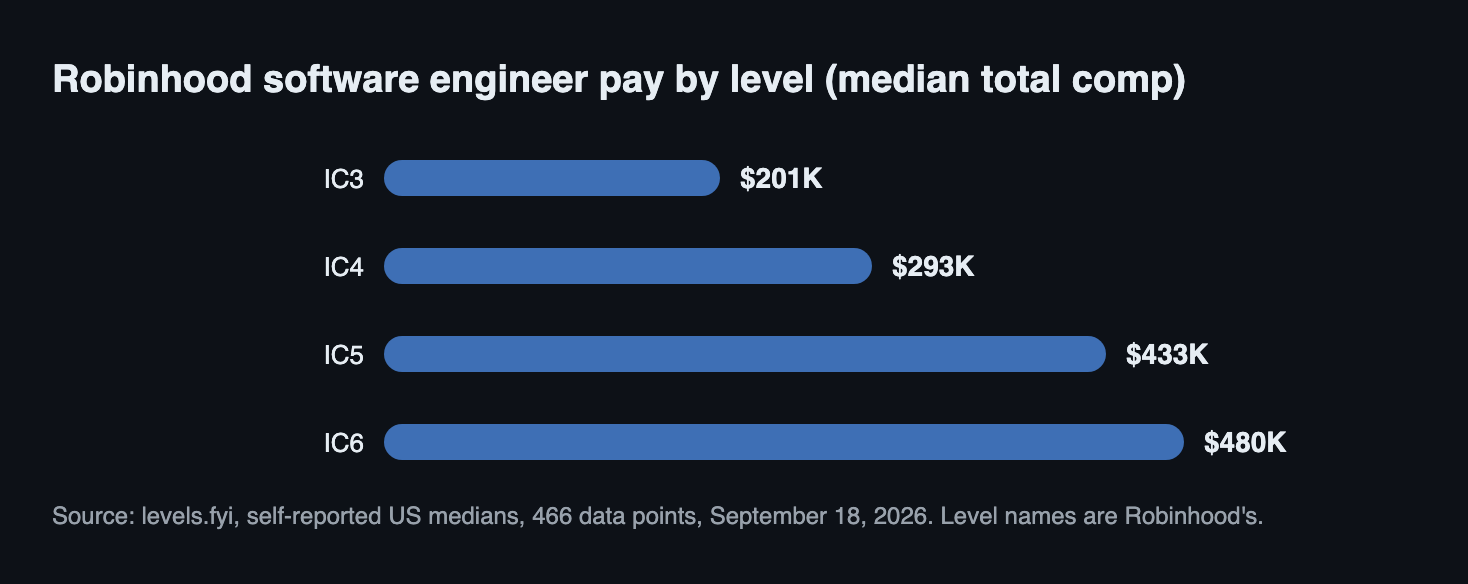
Splits, for shape: IC3 is about $140K base, $49K stock, $12K bonus. IC4 about $190K base, $84K stock, $19K bonus. IC5 about $229K base and $181K stock. IC6 about $231K base and $236K stock, the first level where stock passes base. Above IC6 the sample thins out; treat anything you see there as anecdote.
Three structural points:
→ Posted base ranges are real and public. Every Robinhood req prints a Zone 1 base range (Menlo Park, New York, Bellevue, DC), and most print Zones 2 and 3. Current examples: Software Engineer, Backend at $166,000 to $195,000; Senior Software Engineer, Backend at $196,000 to $230,000; Staff Software Engineer, Event Contracts at $230,000 to $270,000; Senior Staff Software Engineer, Core Infrastructure at $264,000 to $310,000. Zone 2 runs about 12% lower and Zone 3 about 22% lower. Toronto is its own scale: Senior Software Engineer, Wallet at CAD $166,000 to $195,000. Read the levels.fyi medians against those bases and the gap is the stock.
→ The vest is fast. Levels.fyi's Robinhood page describes RSU schedules of one to four years, with the most common a two-year schedule weighted to the first year. That is unusual for a public company and it changes the math on an offer: a grant that mostly vests in 24 months is worth more than the same headline number on a four-year cliff-and-quarterly schedule, and it also means your retention grant conversation comes early. Ask for the exact schedule in writing.
→ Value the equity as a public stock, because it is one. No 409A guesswork. The price is on the screen, the company is profitable, and a market cap near $100 billion means the upside case is a growth story, not a re-rating story. That's a better position than most fintech equity in 2026, and a more volatile one; the shares that funded a 10% cut in June were the same shares trading at an all-time high in September.
Robinhood has no published no-negotiation stance. Candidate reports describe ordinary negotiation on level and equity.
What is Robinhood actually screening for?
Seven published values, and unlike most company-values pages, this one shows up word for word in the behavioral round.
Robinhood's about page lists them with one line each: Insane Customer Focus ("our customers are why we exist"), High Performance ("we operate with extreme urgency"), Safety Always ("trust is hard earned and easily lost"), One Robinhood ("we're all invested in the same mission"), Participation is Power ("we level the playing field"), First Principles Thinking ("we only follow the crowd when they're right"), and Lean & Disciplined ("we do more with less"). Candidate guides report the behavioral round mapping questions to these directly, with a follow-up asked "almost every round": what would you do differently.
Read them against the June memo and the loop makes sense. Lean & Disciplined and High Performance are the "elite performance bar" in value form; the interviewers want a story where you carried more scope than the org chart implied. Safety Always is the design round: the brokerage-under-failure question is a values question with a whiteboard. First Principles Thinking is why the interviewers steer; they are checking whether you reason from the system or from a template. Insane Customer Focus in a brokerage context means "a retail customer's fill at 9:31 is real money," and the strongest behavioral answers put a customer outcome at the center of a technical decision.
Two practical implications. Prepare stories with quantified outcomes and second-order lessons, because the follow-ups will go there. And prepare one honest failure with a specific recovery; a loop that asks "what fails, what happens next" in the design round asks the same thing about your career in the behavioral one.
Which Robinhood engineering roles are open right now?
As of September 18, 2026, 155 roles on the board and 54 individual-contributor engineering reqs. The clusters, with the location strings as posted:
→ Crypto and tokenization: Software Engineer and Senior Software Engineer, Tokenization (Menlo Park/New York, and a Toronto listing); Senior and Staff Software Engineer, Web3 (Menlo Park/New York and Toronto); Senior Software Engineer, Wallet (Menlo Park/New York and Toronto); Senior iOS Engineer, Crypto Trading (New York); Senior Android Engineer, Crypto Expansion. This is the biggest cluster and it tracks Robinhood Chain and stock tokens.
→ Trading and markets: Staff Software Engineer, Event Contracts (Menlo Park/New York, base $230K to $270K); Senior Android Engineer, Trading Products; Senior Software Engineer, Prime (London and Ljubljana); Senior Software Engineer, Custody Services (London).
→ Platform and infrastructure: Senior Staff Software Engineer, Core Infrastructure (Menlo Park and Bellevue, base $264K to $310K); Staff and Senior Staff, Data Platform and Storage Platform (Bellevue); Senior Software Engineer, Streaming Platform and Kubernetes Compute (Bellevue); Senior Software Engineer, Cloud Networking; Staff Software Engineer, Observability; Senior Software Engineer, Load and Fault Environments (Menlo Park). Bellevue is effectively the platform office.
→ Developer infrastructure: Staff and Senior Staff Software Engineer, Developer Infrastructure and DevX (Menlo Park/New York); Senior Software Engineer, Enterprise Build.
→ Security: Senior Software Engineer, AI Security; Staff and Senior Offensive Security Engineer (Bellevue, Denver, Menlo Park, New York, plus Toronto); Staff Security Engineer, Detection & Response; Senior Staff Software Security Engineer; Senior Software Engineer, Security Platform. The only reqs that list Denver.
→ Product and consumer: Software Engineer and Senior Software Engineer, Backend (Menlo Park/New York, bases $166K to $195K and $196K to $230K); Full Stack Software Engineer, Credit Cards & Banking; iOS and Android Engineers on Government Products (New York), Money Experience, Social, and Wallet; Staff Android Engineer; Senior Software Engineer, Robinhood Command Center (Menlo Park and New York).
→ ML: Machine Learning Engineer (Bellevue); Staff Machine Learning Engineer, AI R&D (Bellevue and Menlo Park); Senior Software Engineer, Data Engineering.
Half the reqs were posted or refreshed in September. Every one of them says three days in the office. There is no remote engineering req on the board, and the postings' pay zones (down to Florida) describe office cities, not home states.
How should you prep differently for Robinhood?
Assume the loop is a design loop with a coding gate in front of it, and prep the domain, not the pattern.
→ Design a brokerage, out loud, three times. Order intake, exactly-once placement, the ledger, market-open bursts, then break it: the queue backs up, the cache goes stale, the primary database fails mid-fill. Practice saying what the customer sees at each failure and how the system recovers. This is the round. Kafka and pub/sub vocabulary is expected; consistency and idempotency arguments are graded.
→ Bring a system you built and know its failure modes better than the interviewer. The project deep dive is the round where candidates get steered hardest. Pick something with real load or real money, and be ready for "what would you do differently" as a genuine question.
→ Do the CodeSignal warm-up even if you think you'll skip it. Four tasks in 90 minutes, proctored, is a pace, not a difficulty. If you're senior and it's waived, you lost an afternoon. If it isn't, you're ready.
→ Answer the AI question before they ask it. Have a concrete account of how you use an agent, what you check, and one place it burned you. At a company where the CEO says most new code is AI-written, this is a competence question, not a culture question.
→ Decide on the office before the recruiter screen. Three days in Menlo Park, New York, Bellevue, or Toronto is the deal, and the first call will ask. There's no remote answer that ends well.
→ Apply the day the req opens. Half the board turned over in September. Robinhood's loop rewards early applicants the same way every high-volume brokerage req does: the first tranche gets read. The recency case applies here without modification, and it's what hirecomb is built to do for you across every fintech board: match your résumé against new reqs the morning they post, tailor, and apply while the pile is short.
Be first on the next Robinhood req
FAQ
Is Robinhood still hiring engineers after the June 2026 layoffs?
Yes. The June 16 cut was about 290 people, roughly 10% of a 2,900-person workforce, and the company said it also closed a small number of open roles. As of September 18, 2026 the board lists 155 open roles, 54 of them individual-contributor software, ML, and security engineering, with about half posted or refreshed in September. The cut was framed as raising the performance bar, not shrinking engineering.
Does Robinhood ask LeetCode questions?
The coding rounds are algorithmic (data structures, graphs, heaps, dynamic programming, basic concurrency), and junior loops often start with a proctored 90-minute CodeSignal assessment of about four tasks. But the loop's weight, especially at senior levels, is system design: brokerage and distributed trading systems under failure. Candidates who prep only algorithms consistently report being surprised by how much of the onsite is design.
How much does a Robinhood software engineer make?
Per levels.fyi (466 US data points, September 18, 2026), median total compensation is about $201K at IC3, $293K at IC4, $433K at IC5, and $480K at IC6, with an overall US median of $307K. Posted Zone 1 base ranges (Menlo Park, New York, Bellevue, DC) run $166K to $195K for Software Engineer, $196K to $230K for Senior, $230K to $270K for Staff, and $264K to $310K for Senior Staff. Equity is public RSUs on a fast, often two-year, vest.
Is Robinhood remote?
Not for engineers. Robinhood declared itself remote-first in January 2022 and reversed it; the CEO said in August 2025 he regretted the decision "pretty much immediately." Current policy is three days a week in the office for individual contributors, four for managers, five for executives, and every engineering posting states "in-person attendance expected at least 3 days per week." Engineering offices are Menlo Park, New York, Bellevue, Toronto, Denver (security), London, and Ljubljana.
Sources: June 2026 layoffs and CEO statements, Yahoo Finance / Quartz, "Robinhood layoffs see company cut 10% of workforce" (June 16, 2026). Second-quarter results and product launches, Robinhood Q2 2026 results (July 29, 2026) and the earnings call transcript. Market capitalization, MacroTrends, HOOD market cap (September 14, 2026). "More software engineers in 10 years," a16z on X, from The a16z Show (March 25, 2026). AI-generated code share and tool adoption, Entrepreneur, on Tenev's 20VC appearance (July 17, 2025). Office policy and the remote-first reversal, Fortune (August 14, 2025) and Robinhood newsroom, "Robinhood is a remote-first company" (January 2022). 2022 layoffs, TechCrunch (August 2, 2022). Open roles, locations, posted base ranges, benefits language, and office-attendance language, Robinhood careers (Greenhouse job board), read September 18, 2026. Compensation medians and vesting, levels.fyi, Robinhood Software Engineer, United States (September 18, 2026). Interview loop structure, TechPrep, "Robinhood's Interview Process (2026)", Interview Query, Robinhood Software Engineer guide, and the first-hand senior report at Exponent (2026). Glassdoor aggregates, Robinhood Software Engineer interview questions, per search snippet. Company values, Robinhood, About us. FINRA penalty, FINRA news release (June 30, 2021). Interview stages and AI-tool policy are candidate-reported unless attributed to Robinhood; confirm specifics with your recruiter.