Career Advice
How to Ask for a Referral Without Being Awkward (Engineer's Guide)
David Eric ·

The awkwardness comes from a misread of what you are asking for.
Most engineers treat a referral request as asking a favor: you want something, the other person has to spend reputation to give it to you, and you have nothing to offer back. Framed that way, of course it feels bad. But that is not the transaction. At most tech companies, a referral is a process the employer built, pays for, and actively begs its engineers to use. Your contact fills in a form, the recruiter gets a candidate with a name attached, and if you get hired your contact gets a bonus. You are not asking someone to stick their neck out. You are asking them to click a button their employer wants clicked, on a candidate they can honestly say something about.
Once you see it that way, the etiquette gets simple. Make the yes easy, make the no easy, and do not make anyone guess what you want. This guide covers why referrals work as well as they do, who to ask, the exact messages for each situation, and what happens after.
Why do referrals work so much better than applying cold?
Because they put you in a different queue, with a human vouching for you at the top of it.
The cleanest data on this comes from Ashby, whose 2025 report looked at 38 million applications across 93,000 jobs from 2021 through 2024. Referred candidates went from application to interview about 40% of the time. Inbound applicants, the people who found the posting and clicked apply, went to interview about 3% of the time. The gap holds at the offer stage: referred candidates received offers at 7.3% by late 2024, cold applicants at 0.2%.
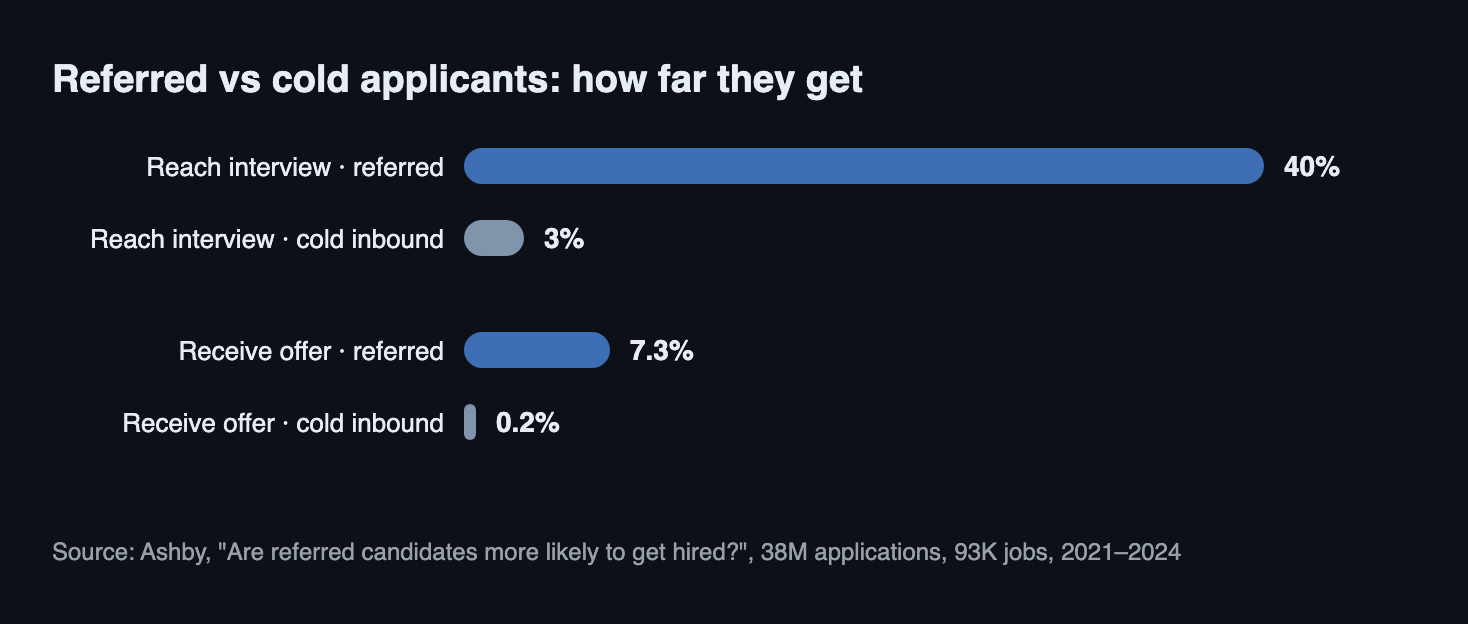
Two things about that chart. First, a referral is not a job. Six in ten referred candidates still do not get an interview, and most who interview do not get an offer. What the referral buys you is a human read of your application instead of a ranked-and-filtered one, which in 2026 is the scarcest thing in the funnel. Second, referrals are shrinking as a share of applications, from about 2% in 2021 to under 1% by 2024 in Ashby's data, while cold application volume has exploded. That makes each referral worth more to the recruiter, not less. They are drowning in inbound; the referred candidate is the one file with a name on it.
The academic evidence says the effect is not just recruiters playing favorites. A 2015 study in the Quarterly Journal of Economics, using personnel records from nine firms including high-tech, found referred applicants were more likely to be hired and to accept offers even though their measurable skills looked the same as everyone else's, and that referred workers were 10 to 30% less likely to quit. A New York Fed study of one large US corporation found the same pattern: referred candidates more likely to be hired, and longer tenure once in. Firms have learned this. It is why they pay for it.
Which brings us back to the bonus. Referral bonuses at tech companies commonly run from a couple of thousand dollars for a mid-level engineer to five figures for senior and AI roles, usually paid once the hire clears a 90-day mark. Your contact's employer has literally put a price on the thing you are nervous about asking for.
Why does asking feel awkward, and why is that the wrong instinct?
Because you are imagining the ask from the perspective of someone who owes you nothing, and forgetting that you are the one holding the risk, not them.
Walk through what actually happens when a former teammate refers you. They spend two minutes in an internal tool. A recruiter reads your resume with their name attached. If you are a fit, the recruiter reaches out; if not, nothing happens and nobody thinks less of your contact. The only way a referral costs them anything is if they vouch hard for someone they cannot actually speak to, and you are going to give them a way to avoid that.
The engineer's version of the awkwardness usually has a second layer: you do not want to look like you are networking. Most of us have a low tolerance for the performance of it. Good news: the referral ask is the least performative form of networking there is, because it is transactional, short, and specific. There is no coffee chat you have to fake enthusiasm through. You send one message with one clear question and a way to say no.
The awkward version of the ask is the vague one. "Hey, long time! Are you still at X? I'd love to catch up sometime." Your contact now has to guess whether you want a job, a referral, or a coffee, and decide how to respond to a question you did not ask. The direct version is a relief to receive.
Who should you ask?
The person who can say one true sentence about your work, at a company with an open role you actually fit. In that order.
A referral's weight comes from what the referrer can say. Recruiters know the difference between "worked with them for two years, would hire them again" and "we were in the same Slack." So rank your list by how much the person has actually seen:
→ Former teammates and managers. People who have reviewed your pull requests, been on call with you, or shipped something with you. This is the tier where a referral is close to a warm intro to the hiring manager. Ask them first, and ask them even if you have not spoken in three years. Engineers move companies constantly and everyone understands the outreach.
→ People you have worked near. Cross-team collaborators, someone you did an incident retro with, a contractor you overlapped with. They can honestly say "I've worked with them and they were solid," which still beats nothing by a wide margin.
→ Alumni, meetup acquaintances, open-source collaborators. Someone who has seen a talk you gave or merged a PR of yours into their project can say something real. Same school with no interaction cannot. For this tier, ask for a short conversation about the team before you ask for anything else, and let the referral come up naturally.
→ Strangers. Cold-messaging an engineer at a company you have never touched is not a referral request; it is a request for a conversation. Some people will refer strangers, particularly at companies with generous bonuses and referral-friendly cultures. But the right first message asks for fifteen minutes to learn about the team, not for their name on your application.
Two engineer-specific notes. First, prefer the person on or near the team with the opening over the more senior person elsewhere in the company. A referral into the hiring manager's own org gets read differently than one routed through a general queue. Second, if you know the company uses a public API, an open-source project, or a developer community, maintainers and active contributors there are often the most reachable engineers you will find, and they tend to be the ones who refer.
What exactly do you say?
Something short that names the role, says why you fit in three lines, and makes both yes and no easy. Here are the versions.
A former teammate you know well:
Hey Priya, hope the new place is treating you well. Quick one: Ramp has a Software Engineer, Payments Platform role open (link) and it lines up closely with the ledger work we did on the settlement service. Would you be comfortable referring me? Totally fine if not, or if you'd rather I just apply and mention your name. If yes, I'll send you a three-line blurb and my resume so it takes you two minutes.
Someone you worked near but not with directly:
Hi Marcus, we overlapped at Acme when I was on the data platform team and you were on infra; we did the Q3 incident retro together. I'm looking at the Backend Engineer, Developer API role at your company (link) and it's a close match to what I've been doing since. I know we didn't work together day to day, so no pressure at all. If you'd be open to referring me or pointing me to the right person on that team, I'd appreciate it either way.
An alumni or acquaintance, where you have not earned the ask yet:
Hi Dana, we met briefly at the Rust meetup in June. I'm considering applying to the Infrastructure Engineer role at your company and wondered if you'd have fifteen minutes in the next couple of weeks to tell me what the team is actually like. Not asking for anything beyond that; I'd rather know if it's a fit before I go further.
Then, if the conversation goes well, at the end: "Would it make sense for you to refer me, or would you rather I apply directly?" You have given them a graceful out.
A stranger at the company, cold:
Hi Sam, I've been reading your team's engineering posts on the queue migration and I'm looking at the Software Engineer, Core Product opening. Would you be open to a quick chat about what the team's working on? Happy to work around your schedule, and no worries if you're slammed.
Notice what is not in that message: a resume, a request for a referral, or an apology. Ask for the referral only after they have talked to you.
The follow-up when you hear nothing:
Hey, following up on this once in case it got buried. No pressure at all; if it's not a good time or not something you're up for, that's completely fine and I'll just apply directly.
One follow-up, five to seven business days later. Then stop. Silence is a no, and treating it as one preserves the relationship for next time.
The packet you attach the moment they say yes:
→ The exact posting link and the req ID if there is one. → Three lines, written in plain English, that they can paste into the referral form: what you do, the one thing you have built that maps to the role, and why this team. Not a paragraph; a paste-able blurb. → Your resume as a PDF, already tuned to the posting. The ATS-proof resume guide covers what that means in practice. → One line telling them how strongly you would like them to vouch: "Feel free to just submit it, or if you're comfortable saying you'd work with me again, that would help." This is what lets a contact refer you honestly without overstating what they know.
The packet is the whole trick. Referrals die because the referrer opens the internal form, realizes they need a link and a summary, and closes the tab meaning to come back. Give them nothing to look up.
What should you never do?
A short list, in order of how often engineers do it anyway:
→ Ask a stranger for a referral in the first message. It is the single most common mistake and it converts terribly. The person cannot say anything true about you. Ask for a conversation.
→ Ask three people at the same company. Referral systems flag duplicate submissions, and recruiters notice. Pick one person, the one closest to the team. If they decline, then ask the next.
→ Ask before reading the posting. "Any openings for backend?" pushes the work onto your contact. Find the specific role, read it, and ask about that one.
→ Ask for a vague "good word." It is not actionable and it puts your contact in the position of lobbying rather than clicking a button. Ask for the referral, name the role.
→ Send a message that reads like a template. If you generated it with an AI assistant, cut everything that could have been written about any company and any person. The two or three specific details are the message; the rest is packaging.
→ Vanish afterward. Tell them when you hear from the recruiter, when you interview, and how it ends, including rejection. People refer the same person twice when they were kept in the loop the first time.
→ Get the referral and then not apply. At many companies the referral form does not create your application; it attaches to one. Ask your contact whether you should apply first or wait for the recruiter, then do what they say quickly.
What happens after they say yes?
Usually one of three things, and you should know which one you are in.
The recruiter reaches out within a week or two. This is the common case when the referral is into an active req and your resume fits. You are now in the 40% queue from the chart above. The process from here is the normal loop; the referral does not skip rounds, it got you into them. Prep the way you would for any interview; our behavioral interview guide and the company guides cover the specifics.
Nothing happens. Referred does not mean reviewed by a human that day. Give it two weeks. Then send your contact a low-pressure note: "No word yet on the payments role. If you happen to know the recruiter on that req, would you mind checking whether it landed? If not, no worries." This is a reasonable ask once. It is not reasonable a second time.
A polite no. Sometimes the role is closed, the team is over headcount, or the recruiter passes on the resume. Thank your contact anyway, specifically. They spent their credibility, and the outcome was outside their control. That thank-you is what makes them a referral source for the next role, at the next company they land at, which for engineers means every two to four years for the rest of your career.
And on the reciprocity question, since it is the other half of why this feels awkward: refer people. When you have a job, use the form. It is the fastest way to stop feeling like referrals are a one-directional favor, because you will discover from the inside that they are nearly free to give and that you are happy to give them to anyone you can say one true sentence about.
How does this fit with the rest of the job search?
Referrals are the highest-yield channel and the lowest-volume one, so they cannot be the whole strategy.
Do the math. A strong engineer with a decade of work has maybe fifteen to thirty people who could honestly refer them, spread across perhaps ten to twenty companies. Some of those companies have no fitting role open right now. So in any given search you will get a handful of referrals, and they will be the best applications you send. Meanwhile there are hundreds of relevant postings you have no contact at, and the freshness data says the ones you apply to in the first day or two are the ones where a cold application still gets read.
That is the split that works: referrals for the companies where you have a person, applied to carefully and early, and a fast, well-targeted cold-application layer for everything else. That second layer is the tedious part, which is the reason ApplyIn exists; it watches for new postings that match your stack and applies the day they go up, so the cold channel runs at the freshness the data rewards while you spend your own hours on the messages above.
One last thing worth saying plainly. Ask. The failure mode for most engineers is not the awkward message; it is the message never sent, to a former teammate who would have said yes in thirty seconds and been glad to be asked.
FAQ
Do I need to know the person well to ask for a referral?
You need them to be able to say one true thing about your work. A former teammate qualifies even after years of silence. An acquaintance from a meetup or an open-source project qualifies if you have actually interacted. Someone you have only ever seen on LinkedIn does not, and the right ask there is a short conversation, with the referral coming up afterward if it goes well.
Should I apply first or wait to be referred?
Ask the person referring you. At many companies the referral form attaches to an existing application, so you should apply and send them the confirmation. At others the referral creates the candidate record and applying separately creates a duplicate. Your contact knows which their company uses; a one-line question saves everyone a mess.
What if they say no?
Thank them and move on, with no follow-up ask. People decline for reasons that have nothing to do with you: they are new and do not feel they can vouch yet, they have already referred someone for that role, or they are leaving. A gracious response to a no keeps them as a contact. Then apply directly, early, and tell them you did.
Is it worth asking for a referral to a role that isn't posted?
Yes, but frame it differently. Ask whether the team is hiring or expects to be, and whether they would keep you in mind or introduce you to the hiring manager. Many teams open reqs with a candidate already in hand, and being that candidate is the best position in hiring. Just do not ask them to "refer" you into a role that does not exist; there is no form for that.
The honest summary: referrals move you from a queue where roughly three applications in a hundred reach a human to one where about forty do, and the companies on the other side pay their engineers to make that happen. The ask is not a favor. It is a short, specific message to someone who can say one true sentence about you, with a link, a three-line blurb, a resume, and an easy way to say no. Send it to the closest person to the team, follow up once, tell them how it went, and refer people yourself when it is your turn.
Sources: Ashby Talent Trends, "Are referred candidates more likely to get hired?" (Joel Westmark, 2025; 38M applications, 93K jobs, 2021–2024); Burks, Cowgill, Hoffman, and Housman, "The Value of Hiring through Employee Referrals," Quarterly Journal of Economics (2015); Brown, Setren, and Topa, "Do Informal Referrals Lead to Better Matches?", Federal Reserve Bank of New York Staff Report 568 / Journal of Labor Economics (2016); CareerPlug Recruiting Metrics Report (April 2025); referral-bonus ranges via ERIN and Underdog.io program benchmarks (2026).