Career Advice
How Many Applications Should You Actually Send? The Data
David Eric ·

The people who got hired this spring sent a median of 16 applications. Not 400.
That's ZipRecruiter's second-quarter 2026 survey of more than 1,500 recent hires: a median of 16 applications, 5 weeks of searching, 5 interviews, 2 offers. Huntr's data from 25,000 job seekers tracking their own searches says the same thing from a different angle: two thirds of successful searches ended within 50 applications, and the largest single group found a job between application 11 and application 20.
Meanwhile the advice on every forum, and the pitch from every tool in my industry, is to send more. Two hundred a month. Five hundred. "It's a numbers game." I run an auto-apply company, so I've heard the pitch from the inside, and this post is the case against it, with the data. The short version: your odds per application have roughly halved since 2021, the thing that used to double those odds (tailoring) is worth half what it was, and the recruiter reads the first tenth of the pile. Under those conditions, volume isn't a strategy. It's what you do when you don't have one.
Why did "apply to more" stop working?
Because everyone did it at once, and the pile got read less, not more.
Greenhouse's March 2026 benchmark report, drawn from more than 640 million applications across 6,000 companies, puts the average number of applications per job posting in North America at 244 in 2025, up from 116 in 2022. Over the same three years, the average recruiting team shrank by 56%. Time to fill went up 37%, to about 60 days. Ashby's data, covering 109 million applications, says it now takes 291 applications to make one hire, up from about 100 in early 2021. Employ's benchmark for software and tech specifically: 369 applicants per role.
Here is the number those all resolve into. In 2021, Ashby found that roughly 7 to 8% of applications led to an interview. In the first quarter of 2026, it was 4.7% for business roles and 3.6% for technical roles. Ashby's own summary: candidates are about 50% less likely to get an interview today than they were five years ago.
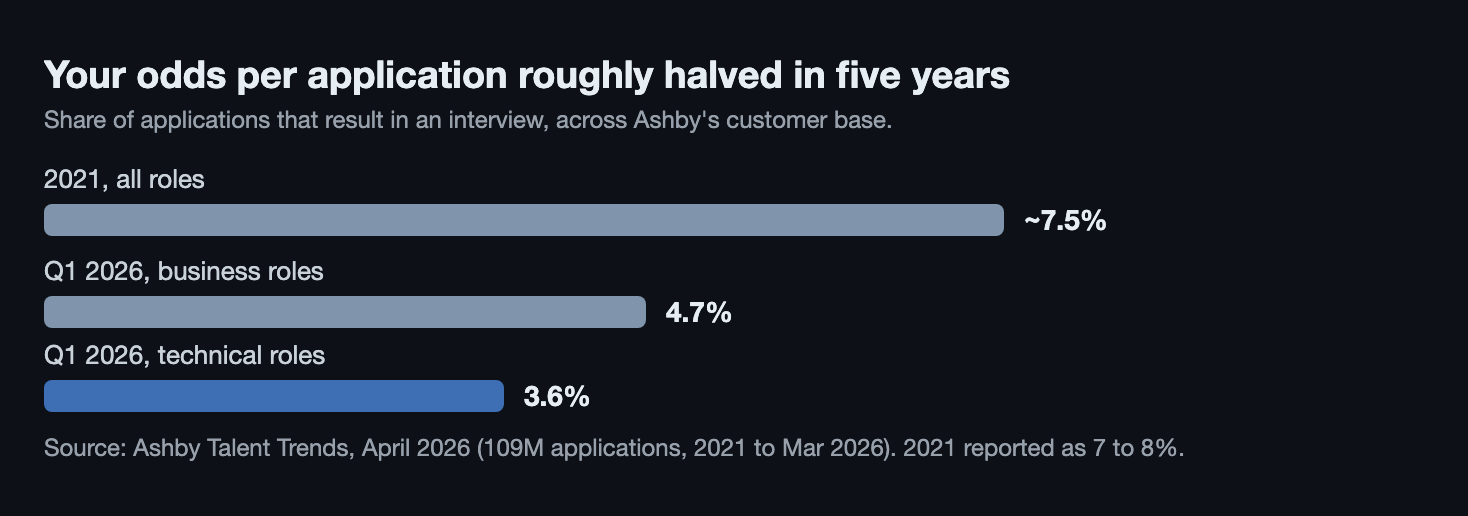
Do the arithmetic the "numbers game" crowd never does. At 3.6%, 100 applications yields about 3.6 interviews. Ashby's stage data says roughly a quarter of screened candidates reach an onsite and about 81% of onsites that go well convert to an offer. So 100 cold applications is, in expectation, a little under one offer. Two hundred is a little under two. You can get there. It costs you two months of evenings, and it's the worst-paying way to do it, because the rate isn't fixed. It's the thing you should be working on.
The one number that predicts whether you get hired
Not how many you sent. What fraction of them were sent well.
Three pieces of evidence, from weakest to strongest.
Tailored applications convert at about twice the rate. Huntr's first-quarter 2026 data, across 140,000 tracked applications: applications sent with a résumé tailored to the posting reached an interview 4.23% of the time, versus 2.07% for an untailored base résumé. That's user-reported and self-selected, so hold it loosely, but the direction matches everything else.
Help with the application raises hires in a controlled experiment. Wiles, Munyikwa, and Horton ran a randomized trial with nearly half a million job seekers on an online labor market, giving the treatment group algorithmic writing assistance on their résumés. The treated group was hired about 8% more often, and employers were no less satisfied with the hires. The assistance didn't change who the person was. It changed how legibly they showed up.
And then AI made the average application worth less. This is the study that should change how you think about the whole category, mine included. Cui, Dias, and Ye analyzed 5 million cover letters submitted to over 100,000 jobs on Freelancer.com before and after the platform shipped an AI cover-letter writer. After launch, the correlation between how well a letter was tailored to the job and whether the applicant got a callback fell by 51%. The correlation with getting the offer fell by 79%. Why? Because more than 75% of the AI-generated letters were submitted within a minute of generation, essentially unedited, so tailoring stopped meaning anything to the reader. A tailored letter used to say "this person spent an hour on you." Now it might say "this person clicked a button." The one variable that still correlated with getting hired: how long the applicant spent editing.
Put those three together. Effort per application still works. But the cheap signals of effort have been counterfeited at scale, so the bar for what reads as effort went up at exactly the moment the tools made it easy to fake. The person sending 400 unedited AI applications isn't just wasting their own evenings. They're the reason the recruiter no longer trusts yours.
Doesn't the data just show that struggling people apply more?
Yes, partly, and you should know that before you quote any of this.
Huntr's buckets show people who sent 11 to 20 applications getting interviews at 9.25% per application, against 2.58% for people past 100. It's tempting to read that as "volume kills your odds." It doesn't say that. People who land interviews early stop applying, so they end up in the low-volume bucket by construction. Faberman and Kudlyak, in a Fed study of online job-application data, found that the longest searches belong to people who search hardest throughout, which is the same selection effect from the other side: high volume is a symptom of a search that isn't working, not the cause.
So the honest claim is narrower than the viral one. More applications don't lower your odds per application. They just don't raise them either, and each one you send at the unedited, untargeted rate costs you the time you could have spent raising the rate on the next one. Volume is neutral. Volume instead of quality is the mistake.
Why the order you arrive in matters more than how many you send
Because the recruiter doesn't read the pile. They read the top of it.
Ashby's VP of Talent, Jim Miller, has written that in high-volume roles "only the first 10% of applications are often reviewed," and that the unreviewed pool "will only get screened if the first tranche of candidates starts to drop out." Ashby's data puts the share of candidates who eventually get screened at 50 to 60%; the rest are never opened. Greenhouse's own guidance to candidates describes companies that "list a job for only a day or two. They open the floodgates, let applicants rush in and pull up the drawbridge."
That changes the math on the 244-applicant posting. You aren't competing against 244 people. You're competing against the two dozen who applied before the recruiter's first pass. Application number 200 on a two-week-old posting is, in most pipelines, an application that will never be read, no matter how good it is. We've written the full recency case, and it's the strongest argument against volume there is: the marginal application in a mass-apply run is almost always a late one.
So what's the number?
There isn't a count. There's a rate and a ceiling.
The rate: every application you send should be to a posting under about 48 hours old, to a role you'd take, that you genuinely match on the core requirements, with a résumé actually rewritten for it, which means you read the description and could name the three things they care about. The ceiling: however many of those you can produce in a week at full quality. For most engineers working a full-time search, that's somewhere between 10 and 25. For most engineers searching around a job, it's 5 to 10.
That range isn't a guess I'm dressing up. It's what the hires in ZipRecruiter's data did: 16 over 5 weeks is about three a week, and it produced two offers. It's what Huntr's successful searches look like: most done inside 50. And it's what Greenhouse's CEO told Fortune this summer when he was asked how to beat the pile: don't apply to the famous company because it's in the news, think of the job you want and apply to the less-known companies doing that work. Lower volume, higher fit.
The check before you send any application. Is the posting fresh? Do you meet the core requirements, not the wish list? Did you change the résumé for this role? Could you say in one sentence why this company? If any answer is no, that application is volume. Skip it and spend the time on the next one.
The part about my industry
Auto-apply tools, including the one I sell, exist because the clerical half of applying is a waste of a human evening. Finding fresh postings, matching them against your background, and typing the same twelve fields for the four hundredth time is exactly what software should do. That's a legitimate product, and we've written about where it stops being one.
Where it stops is when the tool sells the count. A dashboard that celebrates "400 applications sent" is celebrating the thing this entire post says doesn't predict anything. Worse, at scale it's the thing that made tailoring stop working for everyone, the Freelancer.com effect applied to the whole job market. So we built hirecomb to do the opposite of what its category is famous for: score every posting against your actual résumé before anything is queued, tailor to the ones that fit, cap the pace at 10 to 50 a day and two roles per company, and apply from your own browser on postings as they open. Fewer, earlier, better matched. If you want a tool that sends 500 a week, there are twenty in our comparison that will, and the numbers above are what you'll get for it.
Apply to the right ones, early
The stats you'll see elsewhere that don't hold up
Every post on this topic leans on a few numbers that nobody can source. Before you repeat them:
→ "75% of résumés are rejected by an ATS before a human sees them." Traces to a 2012 marketing claim by a résumé-optimization startup that shut down in 2013. No methodology was ever published. Applicant tracking systems rank and filter; the mass auto-rejection story is folklore.
→ "The average job posting gets 250 résumés." Circulating since about 2013 with no dataset behind it. Use Greenhouse's 244 (2025) or Ashby's 291 per hire instead; they're real and, as it happens, close.
→ "Apply in the first 96 hours and you're 8x more likely to get an interview." Real origin: a 2017 blog post by a now-defunct startup, analyzing about 1,600 applications. Small sample, nine years old, original page gone. The recency effect is real; the 8x is not a number you should quote.
→ "Recruiters spend six seconds on a résumé." A real eye-tracking study by Ladders, from 2012, updated to 7.4 seconds in 2018. It's eight years old and the sample size was never disclosed. Directionally fine, precisely meaningless.
FAQ
How many job applications does it take to get an offer in 2026?
For people who got hired in spring 2026, ZipRecruiter's survey found a median of 16 applications, 5 interviews, and 2 offers over about 5 weeks. Huntr's tracked-search data puts two thirds of successful searches inside 50 applications. The cold-application math is worse: at Ashby's 3.6% interview rate for technical roles, 100 untargeted applications yields about one offer in expectation. The gap between those two pictures is targeting, tailoring, and timing.
Does applying to more jobs hurt your chances?
Not per application. The data showing high-volume applicants with worse odds is mostly selection: people whose searches work stop applying early, so they end up in the low-volume group. What hurts is sending volume instead of quality. Each untargeted, unedited application costs the time that would have raised the odds on a tailored one, and at market scale, unedited AI applications have made tailoring worth about half what it was as a signal.
Do AI-written applications get rejected?
There's no primary evidence of ATS systems flagging AI-written text, and claims like "49% of hiring managers auto-reject AI résumés" come from vendor surveys, not studies. What the evidence does show is subtler: a controlled trial found writing assistance raised hires about 8%, and a 5-million-letter study found that once most applicants used AI without editing, tailoring stopped predicting callbacks. Use the tools. Edit the output. Editing time was the variable that still correlated with getting hired.
Is it better to apply early or to apply to more jobs?
Early, and it isn't close. Ashby's talent leadership describes high-volume roles where only the first 10% of applications are reviewed, and Greenhouse describes companies that close postings after a day or two. A late application to a popular posting is often never opened, so adding more of them adds nothing. Ten fresh, matched applications a week beat a hundred stale ones.
Sources: applications and interviews per hire, ZipRecruiter New Hires Survey, Q2 2026 (May 2026). Tracked-search volumes and tailored versus untailored conversion, Huntr Job Search Trends, Q1 2026. Applications per posting, recruiter headcount, and time to fill, Greenhouse Hiring Benchmarks 2026 (March 2026). Applications per hire and interview rates by role type, Ashby Talent Trends: Recruiter Productivity (April 2026) and Recruiting Operations Benchmarks (May 2026). Applicants per software and tech role, Employ 2026 Hiring Benchmarks (January 2026). Writing-assistance trial, Wiles, Munyikwa and Horton, NBER Working Paper 30886. AI cover letters and callback signal, Cui, Dias and Ye, "Signaling in the Age of AI" (working paper, 2025). Search intensity and duration, Faberman and Kudlyak, AEJ: Macroeconomics (2019). First-tranche review, Ashby, "Managing application flows"; "floodgates," Greenhouse candidate guidance (January 2025). Greenhouse CEO on where to apply, Fortune (August 2026). The ATS-rejection and 250-résumé figures are traced in this debunk. Vendor benchmarks reflect each vendor's customer base, not the whole market; treat the direction as solid and the decimals as approximate.