Career Advice
Ghost Jobs: How Many of Your Applications Are Even Real?
Adam Ross ·

You spent forty minutes on that application. Read the posting twice, reordered your bullet points to match it, wrote the short note that doesn't sound like a template. Sent it. Then: nothing. Not a rejection. Nothing.
Here's the question almost nobody asks about that silence: was the job ever real?
Because for a meaningful share of the postings you've applied to this year, the honest answer is no. The role was filled months ago, or frozen, or never existed as an opening at all. The industry has a name for these: ghost jobs. And they are not a fringe phenomenon on sketchy job boards. They're mainstream, measured, and quietly corrupting the math of every job search running today.
One in five postings is never filled
The cleanest number comes from inside the hiring machine itself. Greenhouse, the applicant-tracking platform, classified 18 to 22 percent of the jobs posted on its own platform in any given quarter as ghost jobs, and found nearly 70 percent of companies using it had posted at least one in a single quarter. That's not scraped speculation; that's the pipe reporting on itself.
An independent academic check landed in the same place. Researcher Hunter Ng ran a language-model analysis over roughly 270,000 Glassdoor interview reviews and estimated up to 21 percent of job ads may be ghost jobs — concentrated, uncomfortably, in larger firms and high-skill industries. In other words: not the spammy corners of the internet. The exact companies engineers spend their evenings applying to.
Different data, different methods, same answer. Call it one in five. When you sent your last hundred applications, something like twenty of them went to doors painted on a wall.
Why companies post jobs they don't intend to fill
Not malice. Incentives. A job posting is free to leave up, and every incentive attached to it points away from taking it down.
When MyPerfectResume asked 753 US recruiters about the practice, 81 percent admitted their employer had posted ghost jobs. The reasons they gave are the revealing part:
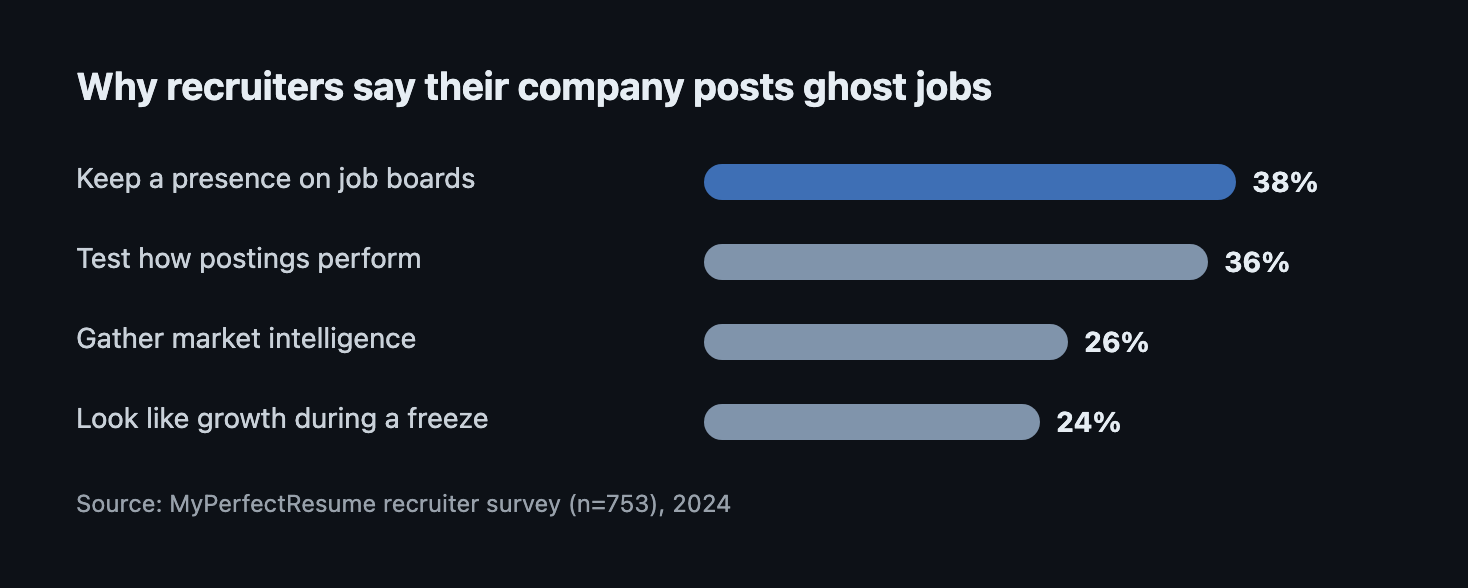
Keeping a presence on job boards. Testing how postings perform. Gathering market intelligence. Looking like growth during a freeze. Read that list again and notice what none of the answers involve: filling the job.
A live req signals momentum to investors, keeps a résumé pipeline warm for "someday," and generates free market data about who's available and for how much. All of that value goes to the company. All of the cost — the tailored résumés, the cover notes, the hope — is externalized onto applicants. Of course the posting stays up. Nobody inside the building pays for it.
The silence does the damage, not the ghost
The forty wasted minutes aren't the real harm. The real harm is what the silence does to your model of yourself.
Every job search runs on feedback: I applied to N roles, I heard back from K, so my hit rate is K over N, so I should fix my résumé, or my skills, or me. But if a fifth of that denominator was theater, the math you're doing on yourself is corrupted at the source. You're computing a batting average that includes at-bats where no pitch was ever thrown — and then blaming your swing.
This is the pattern we keep coming back to in our thesis on why hiring broke: a structural failure that everyone experiences as personal shame. Ghost jobs are the purest example of it. Ng's paper even argues the prevalence of ghost postings helps explain one of the strangest macro facts in the labor data — millions more "openings" every month than hires, a gap that stopped making sense years ago if you assume every opening is real.
And the problem is compounding, not fading. By early 2026, reported candidate ghosting by employers hit a three-year high. The postings look real, the silence feels personal, and the market keeps telling you less and less of the truth.
How to spot a ghost in two minutes
You can't purge ghosts from the market, but you can stop donating your evenings to them. Four checks, about two minutes, before any application you actually care about:
-
Check the posting's age. "Reposted 8 months ago" is not a hiring signal, it's a subscription renewal. The odds a posting is real and reachable are highest in its first days, when the pile is still small. Past a month or two of reposts, assume theater until proven otherwise.
-
Check whether the company is hiring anywhere else. A real opening usually has siblings — other roles on the team, recent hires announced, headcount visibly moving. One evergreen engineering req at a company that hasn't shipped a hire in two quarters is a résumé collector.
-
Read the description for a level. A real req was written for a budget line and reads like it: a level, a team, a concrete problem. A ghost req reads like it could fit three levels at once, because it was written to catch résumés, not to fill a seat.
-
See if the role has been open forever. Some companies keep pipeline reqs permanently live for roles they fill maybe once a year. If you can find the same posting cached from months ago, you're looking at a pipeline, not a position.
None of this guarantees a human reads your application. It just stops you spending real effort on openings that were never openings — which, at one in five, is the single cheapest improvement you can make to your hit rate.
Volume was never the answer
Here's the part where we implicate our own category, because it's true. Auto-apply tools — ours included — made it cheap to fire more applications. But firing more shots into a market where a fifth of the targets are cardboard doesn't improve your odds; it just makes the noise worse for everyone, you included. "Apply to more" is exactly the wrong lesson to draw from ghost jobs.
The right lesson is to be picky and fast: filter out the theater, and reach the real openings while they're days old instead of weeks stale. That's the actual mechanism behind ApplyIn — watching for genuinely new postings and applying while they're fresh — because recency is both the strongest ghost filter and the front of the queue.
If your last hundred applications returned mostly silence, run the math again with the corrected denominator before you conclude anything about yourself. Twenty of those doors were painted on. The rest of the market is real, and it's more navigable than the silence makes it feel — once you stop knocking on the walls.
Sources: Ghost-job share of platform postings and companies posting them, Greenhouse internal platform data as reported by The Wall Street Journal (2024-2025). Academic estimate, Hunter Ng, "Why is it so hard to find a job now? Enter Ghost Jobs," arXiv:2410.21771 (2024). Recruiter admissions and reasons, MyPerfectResume recruiter survey, n=753 (2024). Employer ghosting at a three-year high, Fortune (March 2026). Figures move; verify current numbers before relying on them.