Career Advice
Do Cover Letters Still Matter for Engineers in 2026?
Adam Ross ·

Mostly no.
If you're a software engineer applying through a normal company job board, the cover letter is the least-read thing you'll attach. Half of recruiters skip it entirely. The rest read it after the resume, which means it only matters once the resume has already done its job.
But "mostly no" isn't "never," and the four exceptions are exactly the situations where engineers most often skip it. Here's the short version, then the data behind it:
Skip it when the field is optional, you're a clean fit for the role on paper, and the first reader is a recruiter working a queue.
Write one when the posting requires it, your resume doesn't explain why you fit (career change, gap, unusual stack), the company is small enough that the hiring manager screens applications, or you're sending it through a referral or directly to a person rather than into an ATS.
And in the cases where you do write one: 120 words, three specifics, no story about your passion. The rest of this post is why.
Who actually reads a cover letter?
Depends entirely on who's screening you, and that's the part most advice skips.
Novorésumé's Hiring Landscape 2025 survey of 200+ HR professionals split the answer by role. Recruiters are the least likely to read a cover letter: 52.8% skip them entirely. HR managers are the most likely: only 22.9% skip. Across everyone, roughly 39% don't read cover letters at all, and only 25.7% think a cover letter can tip a decision.
That's the screening layer. Now the hiring-manager layer. Resume Genius surveyed 625 US hiring managers and got a nearly opposite picture: 83% say they read most cover letters, 72% expect one even when the posting calls it optional, and 49% say a strong letter can convince them to interview an otherwise weak candidate.
Both are real. They describe different people at different stages of the same funnel.
For a mid-size or large engineering org, the first human to touch your application is a recruiter or sourcer clearing a few hundred applications for the req. That person is the 52.8%. They're ranking on the resume, sometimes with a model doing the first pass. The cover letter is a link they don't click.
The hiring manager only sees your file after that cut. By then the resume has already sold you. A cover letter can still add color, but it's affecting an interview-or-not decision among a shortlist, not the screen-or-not decision that kills most applications.
So the honest answer to "does anyone read it?" is: the person who decides whether you get a phone screen usually doesn't. The person who decides whether you get an onsite often does. Plan for the first, and write for the second only when you've got a reason.
What does the data say about callback rates?
The only real field experiment on this is still the ResumeGo one, and it's worth knowing precisely.
Between July 2019 and January 2020, ResumeGo submitted 7,287 applications to real postings on ZipRecruiter, Glassdoor, and Indeed, split three ways: no cover letter, a generic cover letter, and a cover letter tailored to the specific job. Then they counted callbacks.
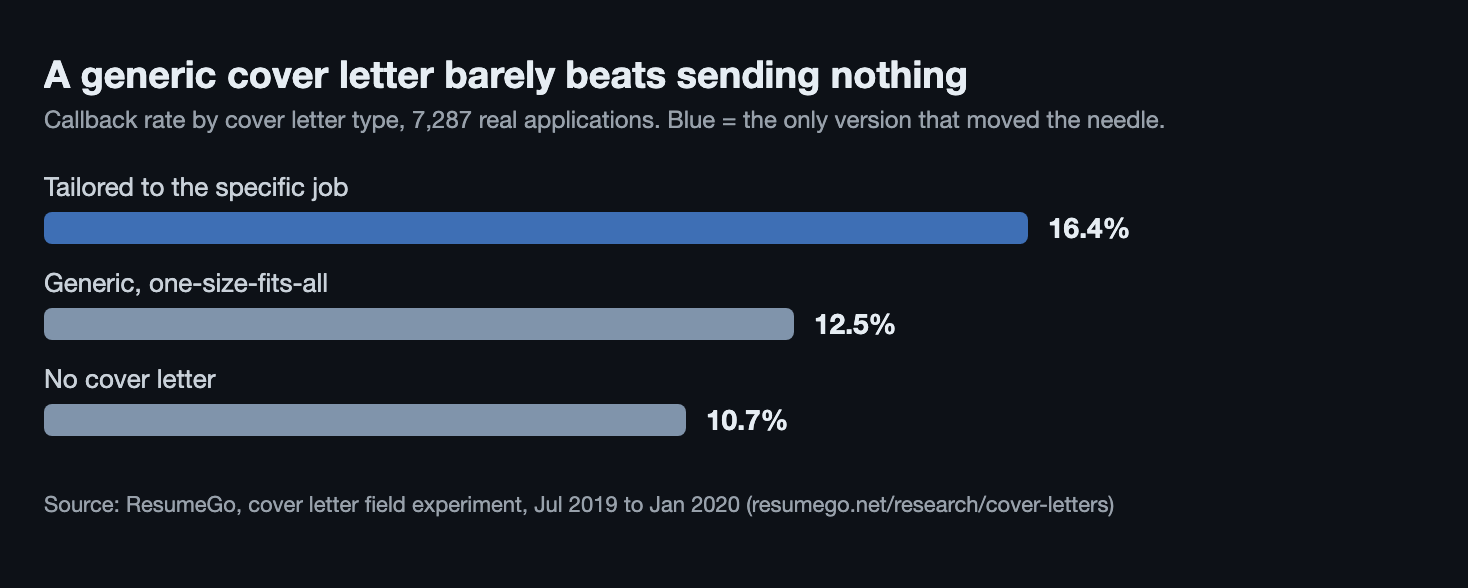
No cover letter: 10.7% callback rate. Generic cover letter: 12.5%. Tailored cover letter: 16.4%.
Two things to take from that. First, tailoring works: a job-specific letter got 53% more callbacks than nothing. Second, the generic letter is almost worthless. It's 1.8 points above silence, and that's before you account for the time it took to write and paste in 300 times.
Three caveats before you over-index. The experiment predates the AI-application era, so the baseline noise in every inbox is far higher now. The postings were general job-board roles, not engineering specifically. And the "tailored" arm was tailored by people who had time, because they were running a study. In a search where you're sending 40 applications a week, nobody is producing 40 tailored letters, which is how engineers end up in the generic arm by default and then conclude cover letters don't work.
They're right about the letter they sent. They're wrong about the letter they didn't.
Why did cover letters lose so much ground for engineers specifically?
Three things happened at once, and none of them was a memo from recruiting.
The applicant pile grew faster than the reading capacity. When a posting draws 200+ applications in the first day, the screen becomes a ranking problem. Rankings run on structured data: titles, years, stack keywords, company names. A cover letter is unstructured prose, and nothing in the first pass is built to consume it. Our post on why the first 24 hours of a posting decide your odds covers what that pile looks like from the inside.
The resume got better at doing the cover letter's job. A modern engineering resume has a summary line, a skills block, and bullets with outcomes. The "why I fit" argument that a cover letter used to carry now lives in the top third of the resume, which is the part that actually gets read. If yours doesn't do that yet, the ATS-proof resume guide is the fix, and it's a bigger lever than any letter.
AI made the generic letter free, which made it worthless. When every applicant can produce a competent four-paragraph letter in eight seconds, the letter stops carrying signal. Insight Global's 2025 AI in Hiring report found 88% of hiring managers say they can tell when candidates used AI on applications, cover letters, or resumes. A TopResume survey of 600 US hiring managers, covered by IEEE-USA, found 19.6% would reject an applicant outright for using generative AI on a resume or cover letter. Tech managers in that piece were more relaxed about AI as a drafting tool, as long as nothing was fabricated. The real penalty isn't for using AI. It's for sending the thing AI produces when you don't give it anything specific to say, which reads as generic because it is.
Put those together and you get the 2026 default: for most engineering applications through an ATS, the cover letter is a box you can leave empty without cost, because the people who'd penalize you for leaving it empty aren't the ones doing the first cut.
When does a cover letter still change the outcome?
Four situations. If you're in one of them, write it. If you're not, don't.
1. The posting requires it. Obvious, but engineers skip required fields more than you'd think and get filtered on the compliance check before a human looks. If it says required, it's a knockout question with extra steps. Write the short version below.
2. Your resume doesn't explain the fit. Switching from backend to ML. Coming back after a 14-month gap. Applying to fintech from a games studio. Twelve years of experience for a role that says "3 to 5." Any time a reasonable screener would look at your resume and ask "why this person, for this?", the cover letter is the only place you get to answer before they move on. This is the case the Resume Genius numbers describe: 49% of hiring managers say a strong letter can rescue an otherwise weak-on-paper candidate. "Weak on paper" is the operative phrase. If the paper is strong, the letter has nothing to rescue.
3. The company is small enough that the hiring manager screens. At a 30-person startup, the engineering lead or a founder is reading applications directly. There is no recruiter layer to skip your letter. You're writing straight to the 83%, and the letter is often the only thing that distinguishes you from the other 40 resumes with the same stack. Same logic applies at bigger companies for niche teams where the manager sources their own pipeline.
4. You're not going through the ATS at all. A referral. A direct message to the hiring manager. A reply to a recruiter's outreach. A note attached to a warm intro. In all of these, the "cover letter" is the message itself, and it absolutely matters, because a person is reading it in a context where reading is the whole point. This is where the cover letter went. It didn't die. It moved from the application form to the inbox, got shorter, and started working again.
Everything outside those four is the optional field on a large company's Greenhouse form for a role you're a clean match for. Leave it blank and spend the twenty minutes on the next application, or on finding a human at the company.
What should an engineer's cover letter look like when you do write one?
Not a letter. A note.
Hiring managers in the Resume Genius survey named 400 words as their preferred length. For engineers writing to engineers, treat that as the ceiling and aim for a third of it. The structure that works, every time:
Line 1: the specific reason you're applying to this role, not this company. Name the team, the product surface, the problem, or the thing in the posting that made you stop scrolling. "Your posting mentions moving the ledger service off the monolith" beats "I've long admired your mission" by a mile, because only one of those proves you read the posting.
Lines 2 to 4: three specifics that map to the posting. Not a restatement of your resume. Three facts, each with a number or a named system, each chosen because it answers something the posting asked for. "Cut p99 latency on a payments API from 800ms to 120ms." "Ran the migration off Postgres 11 for a 2TB database with zero downtime." "Two years on-call for a service doing 40k requests a second." Pick the three that the role would care about, and skip the ones it wouldn't.
Line 5: the fit gap, if there is one, handled in one sentence. "I'm coming from games rather than fintech; the concurrency and latency problems are the same shape, and the domain is what I want to learn." Name it, frame it, move on. Don't apologize for it and don't write a paragraph about it.
Line 6: what you want to happen next. "Happy to walk through any of this on a call." Done.
That's roughly 120 words. It takes about ten minutes if your resume is already in good shape, which is the real constraint: the note is only fast to write when you already know your own three best specifics for this kind of role. If you're using an AI assistant to draft it, feed it those three specifics and the posting and tell it to cut, not add. The failure mode isn't AI. It's AI with nothing to work from, producing a letter that could have been sent to any company, which the reader can tell in one paragraph.
And never, in any version, use the phrase "I am writing to express my interest." The reader knows. It's the first line they see, and it tells them the next 300 words are boilerplate.
Where should the effort go instead?
If the cover letter is mostly dead for large-company ATS applications, the question is what to do with the time.
Three places, in order of return.
Fix the top third of the resume. The summary line and the first three bullets are the cover letter now. They're read on every application, by the recruiter and by whatever model sits in front of the recruiter. Ten minutes tailoring those to a specific posting beats an hour on a letter nobody opens.
Find a human. The referral or the direct note is the cover letter's successor, and it works because it skips the queue where letters go to die. We're publishing a full referral guide later this month with the scripts. The short version: one specific line about why this team, one line about what you've done that's relevant, one ask. Same structure as the note above, sent to a person instead of a form.
Apply earlier. Every reading statistic in this post gets worse as the pile grows. A recruiter clearing 40 applications on day one reads differently than one clearing 400 on day four. The single most reliable way to get a human to read anything you submit is to submit it while the human still has time. That's the whole idea behind ApplyIn: catch engineering postings that match your stack in the first hours they're live and get a tailored application in while the pile is small enough for the resume to be read, and the note, if you wrote one, to be opened.
Cover letters didn't stop working. Generic ones never worked, and the window for the specific ones narrowed to the four cases above. Know which case you're in, write the 120-word version when it applies, and skip it without guilt when it doesn't.
Find fresh engineering postings
FAQ
Should I write a cover letter if the application says it's optional?
For a large company through an ATS where you're a clean fit on paper, no. The first screener is usually a recruiter, and 52.8% of recruiters in Novorésumé's 2025 survey skip cover letters entirely. Write one if you're in one of the four cases above: a fit gap your resume can't explain, a small company where the hiring manager screens, a referral or direct note, or a posting that requires it.
Do hiring managers actually read cover letters for software engineering roles?
Hiring managers, yes, much more than recruiters. Resume Genius found 83% of hiring managers read most cover letters and 72% expect one even when it's optional. The catch is that the hiring manager typically sees your file only after a recruiter has already screened on the resume, so the letter influences the interview decision, not the initial cut.
Can recruiters tell if my cover letter was written by AI?
They believe they can: 88% of hiring managers in Insight Global's 2025 survey say they can spot AI in applications. What they're detecting is genericness, not AI. A letter drafted with AI from three specific facts about your work and the posting reads fine. A letter drafted with AI from nothing reads like every other one in the pile. Tech hiring managers are broadly fine with AI as a drafting tool as long as nothing is invented.
How long should a software engineer's cover letter be?
Hiring managers say 400 words is the preferred maximum. For engineers, aim for 100 to 150: one line on why this role, three specifics with numbers that map to the posting, one line on any fit gap, one line on next steps. Anything longer is asking a busy reader to do work the resume should have done.